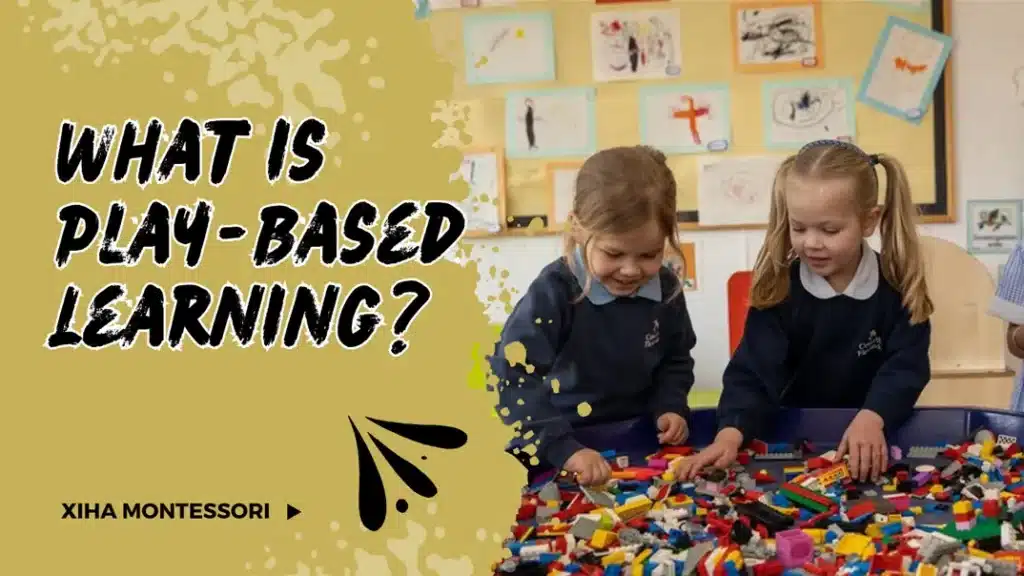
Play-based learning is an educational approach that uses play as the primary way for children to explore ideas, develop skills, and understand the world around them. Instead of separating play from academic learning, this approach recognizes play as a meaningful and purposeful learning process, especially in early childhood education. Through guided play, hands-on activities, and child-led exploration, children actively build knowledge in ways that feel natural and engaging.
The term “play-based learning” is frequently mentioned in early childhood education. Many educators and parents are curious about its effectiveness. But what exactly is play-based learning, and how does it benefit young children?
Rather than relying solely on traditional academic instruction, play-based learning incorporates hands-on activities, games, and imaginative play into the curriculum. Educators can create an environment that fosters creativity, critical thinking, and collaboration by integrating games into the classroom. This approach recognizes that play is an instinct for children and capitalizes on their innate curiosity.
The concept may seem simple, but its applications and benefits are far-reaching. So, if you’re looking for an alternative approach to education that prioritizes fun and engagement, play-based learning could be the answer.
Definition of Play-Based Learning
Play-based learning is an educational approach emphasizing the importance of children learning through play. It is rooted in the understanding that play is natural and critical to a child’s development. Children can choose activities based on their interests in a play-based learning environment, while educators facilitate these activities to meet educational goals.

Here’s a concise breakdown of play-based learning:
- Child-Centered: Children choose how, what to play with, and with whom to play. The learning environment is set up to encourage various types of play and learning experiences.
- Educator-Facilitated: While children lead their learning, educators play a supportive role. They guide the play to enrich the learning experience, ensuring the activities are constructive and aligned with developmental goals.
- Learning through Play: The play itself is seen as a form of learning that naturally encourages children’s cognitive, social, emotional, and physical development. This could include problem-solving, language acquisition, and social interaction skills.
- Holistic Development: It supports all areas of a child’s growth. For example, playing pretend enhances language and creativity; building blocks improves motor skills and spatial reasoning; playing with others boosts social skills and emotional understanding.
- Engaging and Enjoyable: Since play is inherently enjoyable, children are likelier to be engaged. This positive association with learning can foster a lifelong love of learning.
Key Elements of Play-Based Learning
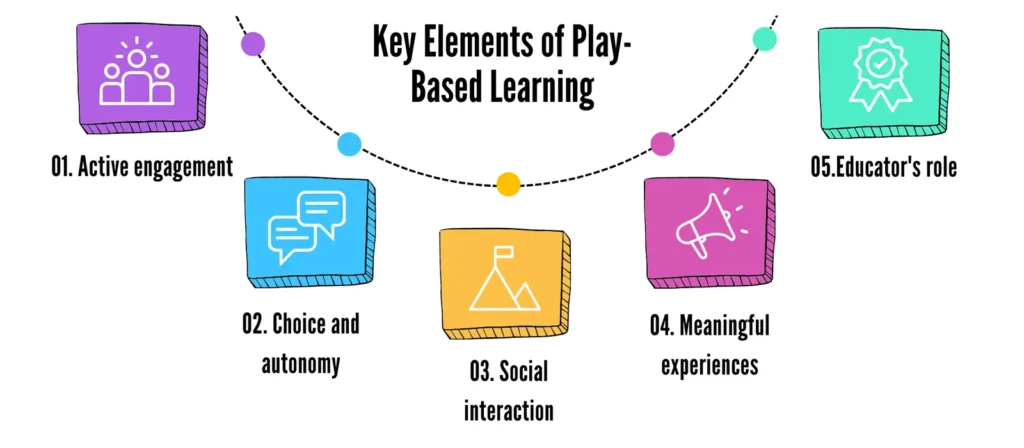
Active engagement
One of the core elements of play-based learning is active engagement. Children are not passive recipients of information but are actively involved in their learning process. This engagement can take many forms, from hands-on activities to interactive play with peers.
Choice and autonomy
The choice is a significant factor in play-based learning. Allowing children to choose their activities gives them a sense of autonomy and ownership over their learning. This freedom encourages them to take risks, try new things, and learn from their experiences.
Social interaction
Social interaction is another critical element. Play-based learning often involves group activities that promote teamwork and communication. Children learn to collaborate, share, and resolve conflicts, essential skills for their development.
Meaningful experiences
Play-based learning is grounded in meaningful experiences. Activities are designed to be relevant to the children’s interests and real-life experiences. This relevance makes learning more engaging and effective, as children can see the practical applications of their learning.
Educator’s role
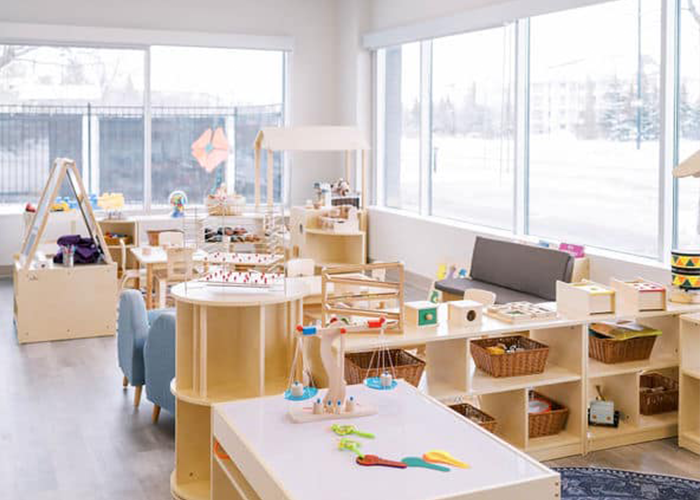
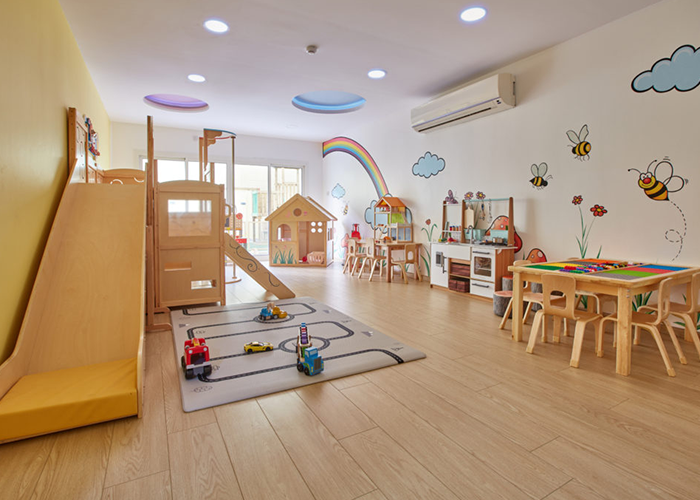
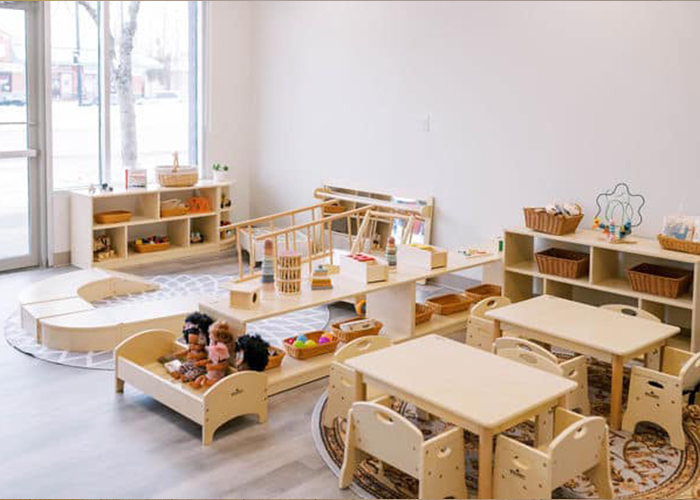
Educators play a vital role in facilitating play-based learning. They create a stimulating environment that offers a variety of play opportunities, from structured activities to free play. Educators observe and interact with children, providing guidance and introducing new concepts when appropriate.
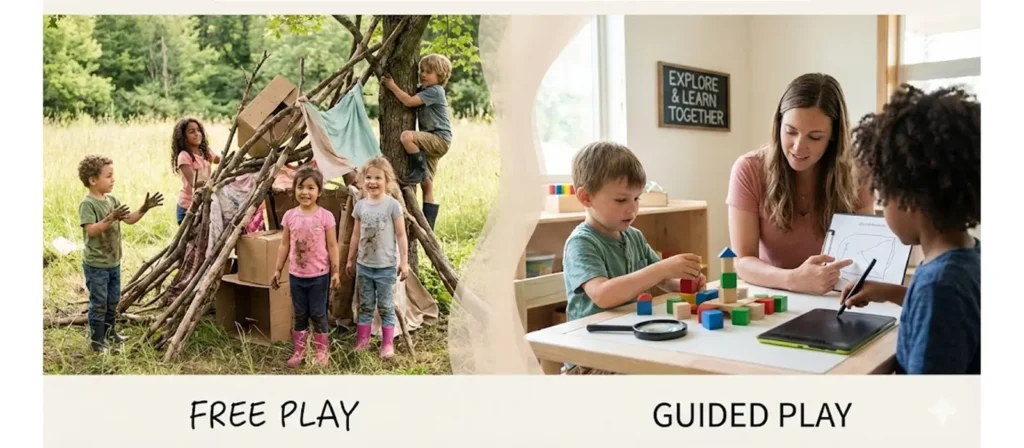
Forms of Play: Free Play and Guided Play
Play-based learning includes different kinds of play. Two of the most important for early education are free play and guided play. Both matter. The magic is in how they work together.
Free Play: Child-Led Exploration
Free play is what most people think of when they imagine children playing without adult direction. The child chooses:
- What they want to do
- Which materials to use
- Whom to play with
- How to structure the activity
In a classroom, free play might look like:
- A child spending 20 minutes building an “airport” with blocks and toy airplanes
- Two children quietly drawing together and chatting about their families
- A group running an imaginary “hospital” in the dramatic play corner
In many American households, free play time has shrunk due to busy schedules, structured extracurriculars, and increased screen time. This makes free play blocks at school even more valuable.
Guided Play: Adult-Framed, Child-Directed
Guided play sits in the sweet spot between free play and direct instruction. Adults set the stage with a learning goal and thoughtfully chosen materials, but children still lead the exploration.
Key features of guided play:
- The teacher has a clear learning objective (for example, practicing counting, exploring shapes, or learning new vocabulary).
- The environment is arranged to encourage that learning (such as a “shape store,” a science investigation table, or a word-building game).
- Children move freely within the setup, make choices, and play in their own way.
- The teacher interacts during play—asking questions, modeling language, and gently nudging children toward deeper thinking.
Guided play is especially powerful in early math, literacy, and science. It respects children’s need for autonomy and joy while ensuring that key concepts and skills are being intentionally nurtured.
What Are the Benefits of Play-Based Learning?
Play-based learning isn’t just “fun for fun’s sake.” It touches almost every area of a child’s development. Below are key benefits that educators and child development experts see again and again when play is at the heart of early learning.
1. Cognitive Skills
Play develops executive function, which includes working memory, flexible thinking, and self-control. When children build towers, create obstacle courses, or experiment with materials, they engage in critical thinking, hypothesis testing, and real-world problem-solving.
These skills are the basis of mathematics, science, and reading comprehension.
2. Fostering Creativity and Imagination
Creativity grows when children are allowed to explore, invent, and transform ideas. In open-ended play settings, children reimagine everyday items and create original narratives. For example, a child may turn a cardboard box into a pirate ship, a time machine, or a kitchen.
This creative flexibility builds innovation, which is increasingly recognized in American schools and workplaces as a vital skill for future success.
3. Social-Emotional Skills
Play supports emotional intelligence by creating opportunities for interaction, empathy, conflict resolution, and collaboration. Through shared experiences, children learn to read social cues, regulate their responses, and negotiate with others.
A group of preschoolers building a zoo together must listen to ideas, compromise on animal placements, and manage emotions when plans change. These experiences help children become socially competent and emotionally resilient.
4. Increased Learning Motivation
Children are naturally motivated when they feel ownership of their learning. Play provides this sense of control. Because it aligns with their interests, it sparks curiosity and enthusiasm.
Instead of being driven by external rewards or pressure, children in play-based settings are driven by joy and discovery. As a result, they engage longer and more deeply with learning materials.
5. Promoting Physical Development
Play helps children develop motor skills. Activities like drawing, stacking, pouring, and cutting improve hand coordination and muscle control. Climbing, running, and jumping build strength, balance, and endurance. These physical experiences support school readiness and contribute to overall health and well-being.
6. Language Development
Playful environments are rich in conversation. Whether during pretend play or cooperative games, children are constantly speaking, listening, and negotiating.
Teachers can support language growth by asking open-ended questions, modeling new vocabulary, and encouraging storytelling. These interactions help children develop their ability to express and understand language.
7. Adaptability and Resilience
When things don’t go as planned in play, children adapt. A structure falls down, a peer suggests a rule change, or materials run out. These unexpected turns build flexibility and the ability to recover from setbacks.
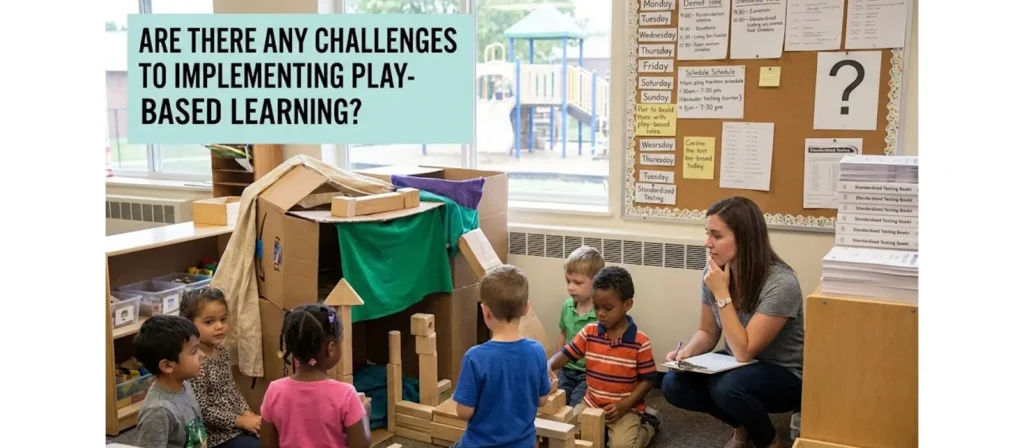
Are There Any Challenges to Implementing Play-Based Learning?
While play-based learning offers numerous benefits, implementing it effectively does come with its set of challenges. Here are some of the common hurdles that educators and schools might face:
Perceptions and Misconceptions
One of the most persistent challenges is perception. Some parents and educators believe that play‑based learning is less rigorous than traditional instruction. They may equate play with “free time” or view academic worksheets as the primary indicator of learning. Overcoming these misconceptions requires clear communication about the learning processes embedded in play and evidence that play supports academic outcomes.
Training and Resources
Implementing play-based learning effectively requires proper training and resources. Educators must be trained in play-based methodologies and provided with the necessary materials to create a stimulating learning environment. This can be a significant investment for schools and educational institutions.
Curriculum Standards and Accountability
In many American school systems, teachers are accountable for meeting rigorous state standards and preparing students for standardized assessments. Play‑based learning, which emphasizes exploration and process, can feel difficult to reconcile with fixed benchmarks and testing schedules. Teachers may worry that too much play will leave students unprepared for standardized assessments or that they lack time to cover required content.
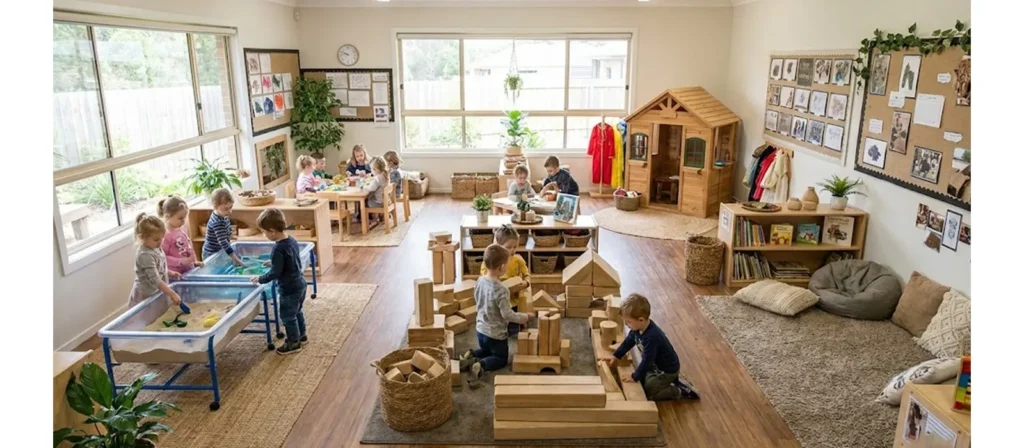
Space and Environment
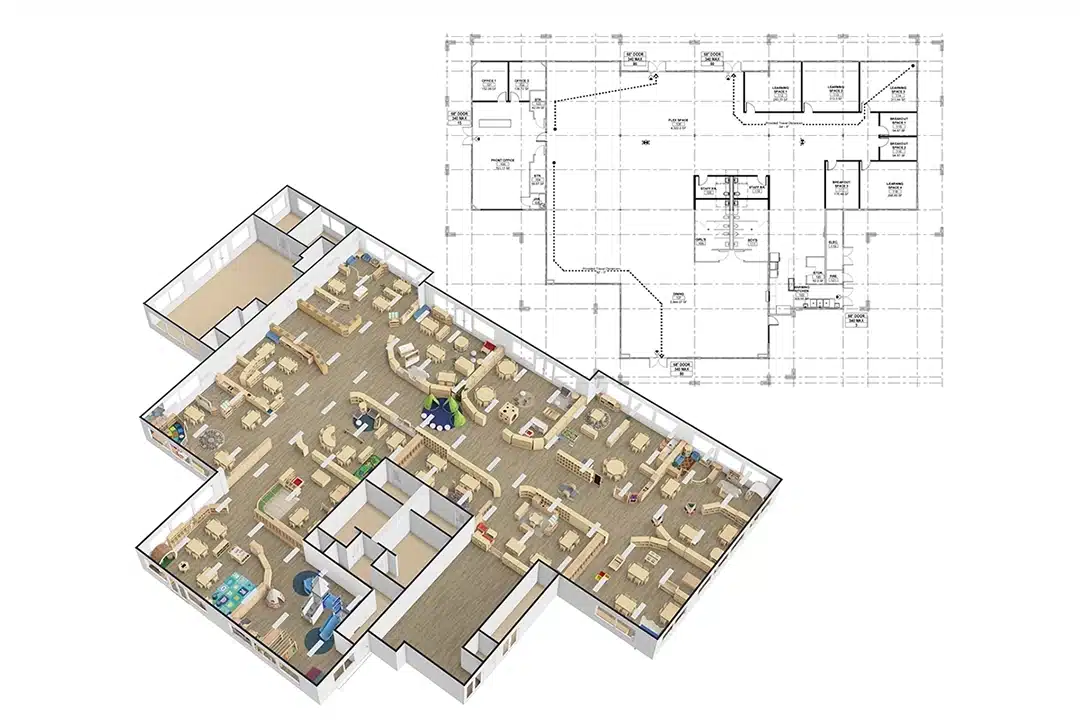
Creating a conducive environment for play-based learning can also be challenging. Schools must have enough space for various play activities to ensure the environment is safe and stimulating. This may require rethinking the classroom setup and investing in new materials and equipment.
Assessment Challenges
Traditional assessments tend to focus on right‑or‑wrong answers. In play‑based learning, learning is often observed through process, language use, problem‑solving, and collaboration. Teachers need assessment tools that capture growth over time and that reflect the competencies developed through play.
Balancing Structure and Freedom
Finally, striking the right balance between child choice and instructional direction can be difficult. Too much structure can stifle creativity, while too little direction can leave learning goals unsupported. Teachers must learn to plan provocations that stimulate inquiry without hijacking the child’s agency.
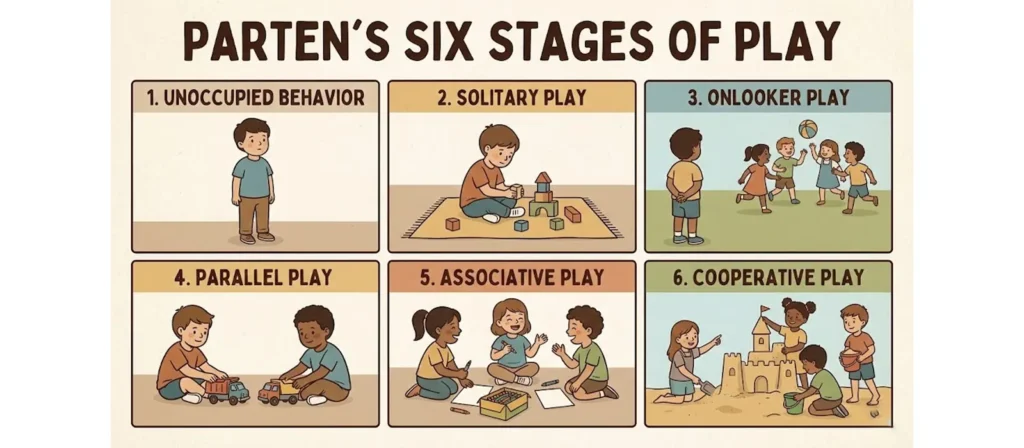
Parten’s Six Stages of Play
Parten’s Six Stages of Play is a classic framework from child development that describes how young children’s play evolves socially over time. While you don’t need to memorize every term to use play-based learning well, understanding the basic idea helps you see children’s behavior as part of a natural progression, not a problem to “fix.” In a play-based classroom, all these stages show up, sometimes within the same hour.
- Unoccupied play: The child appears to be observing, moving around, or not engaged in obvious play.
- Solitary play: The child plays alone, focused on their own activity, not interacting much with others.
- Onlooker play: The child watches others play and may talk about what they see but doesn’t join in.
- Parallel play: The child plays independently but side by side with peers, often using similar toys or activities.
- Associative play: Children begin interacting, sharing materials, and talking, but the play isn’t yet fully organized toward a shared goal.
- Cooperative play: Children organize roles, share a common plan (like building a castle together or putting on a play), and work as a group.
Examples of Play-Based Learning in the American Classroom
Play-based learning activities are designed to engage children in playful experiences that naturally encourage learning and development across various domains. Here are some examples that illustrate how play-based learning can be implemented:
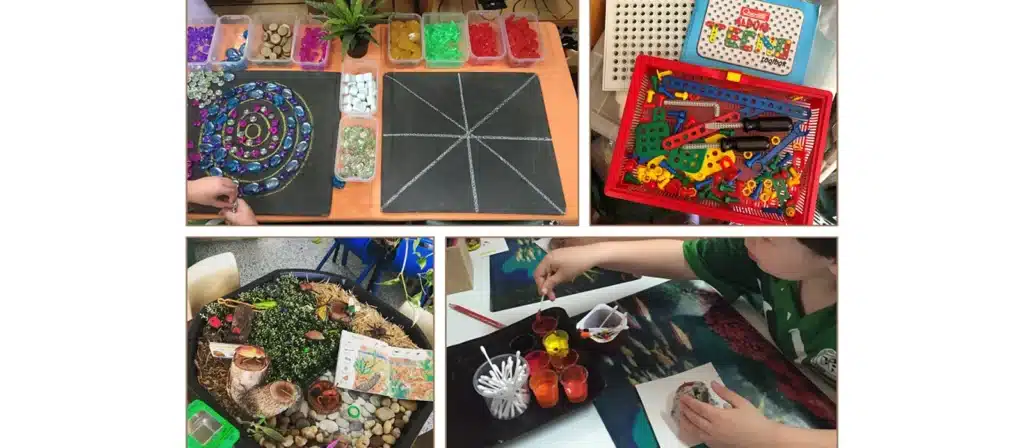
1. Role-Playing and Dramatic Play:
- Setting up a “kitchen corner” or “market store” where children role-play different family roles or professions, learning about social interactions, responsibility, and basic math skills.
2. Building and Construction:
- Using blocks, LEGO, or other construction toys to build structures. This activity promotes spatial awareness, problem-solving, and fine motor skills. It also fosters creativity as children imagine and create their structures.
3. Art and Craft Activities:
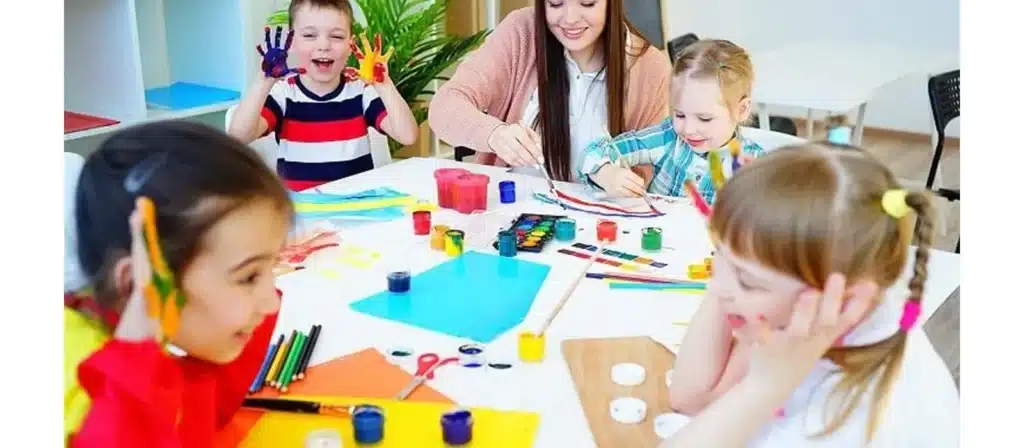
- Engaging in drawing, painting, or crafting. These activities enhance fine motor skills, creativity, and self-expression. They also provide opportunities for children to make choices and use materials in diverse ways.
4. Outdoor Play:
- Activities like sandbox play, water play, or climbing on playground equipment. These experiences help develop physical skills like balance and coordination and encourage children to interact with and explore their environment.
5. Storytelling and Puppet Shows:
- Using puppets or storytelling sessions to spark imagination and enhance language skills. Children can also create their own stories, which helps develop narrative skills and understand sequence.
6. Music and Dance:
- Incorporating music and movement activities, where children use instruments, sing songs, or dance. This improves rhythm and physical coordination and supports emotional expression and cultural awareness.
7. Sensory Play:
- Activities that involve touch, smell, sight, and sound, such as playing with dough, rice, or scented materials. Sensory play supports cognitive growth, fine motor skills, and problem-solving abilities.
8. Group Projects:
- Collaborative projects where children work together to create something, like a large mural or a group storybook. This enhances cooperation and communication skills.
How Does Play-Based Learning Differ From Traditional Learning Methods?
| Aspect | Play-Based Learning | Traditional Learning Methods |
|---|---|---|
| View of the Child | Active explorer, capable of directing their own learning and making meaningful choices | Passive receiver of information who is expected to follow instructions and absorb content |
| Role of the Teacher | Facilitator, guide, and co-learner who designs environments, observes, asks questions, and scaffolds learning | Primary source of knowledge who explains, lectures, and leads most activities |
| Learning Approach | Integrated, hands-on exploration; concepts are discovered and practiced through play and real-world scenarios | Segmented subjects taught in isolation, often focused on listening, memorizing, and repeating |
| Motivation Source | Intrinsic interest, curiosity, and ownership of the activity; learning feels meaningful and enjoyable | External rewards and pressures, such as grades, stickers, praise, or fear of poor test scores |
| Classroom Environment | Flexible, with learning centers, open-ended materials, and spaces for movement and collaboration | Structured primarily around desks or tables facing the front; movement is limited and often tightly controlled |
| Assessment Style | Ongoing observation, documentation of children’s play, portfolios, and performance tasks | Quizzes, tests, and graded assignments; emphasis on correct answers and speed |
Can Play-Based Learning Be Integrated Into a Structured Curriculum?
Yes, play-based learning can be integrated into a structured curriculum, creating a balanced approach that harnesses the benefits of both play and structured educational methods. This integration can enhance engagement, deepen understanding, and support the development of a wide range of skills. Here’s how it can be effectively done:
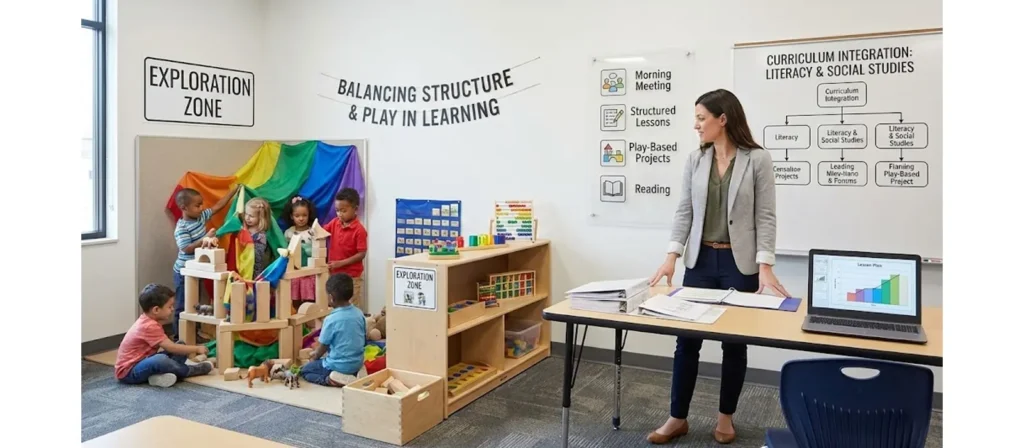
- Curriculum Design: Educators can design their curriculum to include specific times for play-based activities that align with learning goals. For example, a math lesson might include manipulative toys that teach counting and addition, while a science topic could be explored through experiments that feel more like play.
- Learning Centers: Classrooms can be organized into various learning centers, each dedicated to different areas such as science, math, reading, or art. These centers can provide hands-on, playful activities directly tied to the curriculum.
- Thematic Learning: Using themes that capture children’s interests can make learning more engaging. For instance, a unit on space can include role-playing as astronauts, building models of spacecraft, or creating alien landscapes in a sandbox.
- Project-Based Learning: Projects can be a great way to integrate play into structured learning. Children can work on longer-term projects, allowing exploration, creativity, and play while delivering specific educational outcomes.
- Flexible Scheduling: Allowing daily or weekly schedule flexibility can enable educators to use play-based learning effectively. This might mean setting aside blocks of time for exploratory play or having ‘theme days’ that focus on learning through play.
By carefully planning and creatively employing these strategies, educators can build a curriculum that maintains the structure needed to meet educational standards while also embracing the dynamic and engaging qualities of play-based learning. This integration makes learning more enjoyable and relevant for children and promotes a deeper, more holistic form of development.

How Do Educators Facilitate Play-Based Learning?
Educators play a crucial role in facilitating play-based learning. They create a stimulating environment that offers a variety of play opportunities, from structured activities to free play. Educators also observe and interact with children to support and extend their learning, providing guidance and introducing new concepts when appropriate.
The Science Behind Play-Based Learning
Neuroscience shows that children learn more effectively through active, meaningful engagement. During play, the brain forms connections that support memory, attention, and emotional regulation.
Studies by the Harvard Center on the Developing Child and others show that play builds executive function, reduces stress, and supports lifelong learning outcomes.
In fact, children in play-enriched environments tend to score higher in vocabulary and problem-solving assessments by later elementary grades. These findings validate what many early childhood educators already know from experience: children learn best when they are doing, not just listening.
Conclusion
Play-based learning is more than a trend; it is a developmentally sound approach rooted in how children naturally learn. It fosters critical thinking, social skills, resilience, and motivation — all while supporting academic achievement in authentic ways.
Educators and parents who embrace play-based learning not only help children succeed in school but also prepare them for a lifetime of creative problem-solving, collaboration, and joyful learning.
If you’re building a classroom, a homeschool program, or even designing public policy, understanding the value of play can transform how we teach and how children thrive.
If you have any questions or need to purchase furniture for your nursery, please contact Xiha Montessori.
FAQs
- At what age is play-based learning most effective?
It is most effective in early childhood but also beneficial in early elementary grades. - What challenges do teachers face with play-based learning?
Key challenges include curriculum constraints, lack of training, and pressure for standardized assessments. - Can play-based learning meet educational standards?
Yes, when aligned intentionally, play can support standards while enhancing student engagement. - Is play-based learning suitable for all children?
Yes. It supports diverse learning styles and can be adapted for different developmental needs. - How is game-based learning different from play-based learning?
Game-based learning uses specific games with rules and goals to teach content, while play-based learning is broader and includes free play, dramatic play, building, and exploration, with or without formal games. - How much should teachers “step in” during play?
Teachers should observe first, then step in briefly to add language, pose questions, or introduce a new idea, and step back again so children still lead the play. - Can play-based learning work in a small or crowded classroom?
Yes. It just requires thoughtful use of space, clearly defined centers, simple materials, and tight routines so children know where to go, what to do, and how to clean up. - How can parents support play-based learning at home?
Offer open-ended materials (blocks, boxes, art supplies), protect daily time for free play, follow your child’s lead, and turn everyday routines into playful, talk-rich moments.