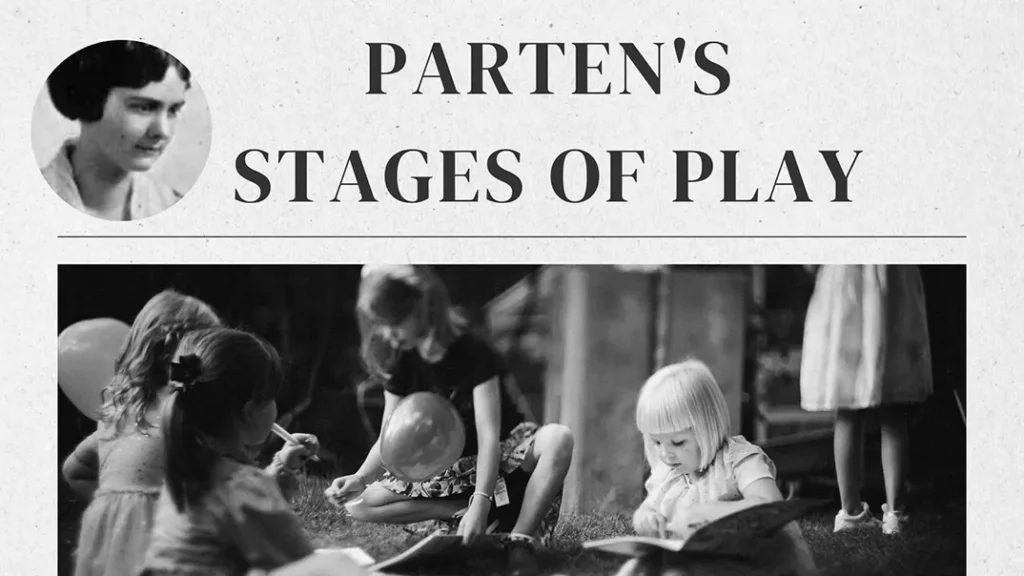
Play is often described as the work of childhood, but few realize how structured this process actually is. In the 1930s, researcher Mildred Parten observed that children’s social interactions during play follow a clear developmental pattern known today as the Stages of Play.
From solitary exploration to fully cooperative group play, these stages of play reveal how children grow socially, emotionally, and cognitively through their everyday interactions. Each step represents a milestone in how children understand themselves and others.
Understanding these stages of play is essential for educators and parents alike. It helps identify where a child is developmentally, set realistic expectations, and design play experiences that promote healthy relationships. This guide walks through each stage with clear examples and classroom insights.
What Are the Stages of Play?
The Stages of Play describe how children’s social interactions and play behaviors evolve as they grow. First identified by sociologist Mildred Parten in 1932, this framework outlines six distinct stages that reflect increasing levels of social awareness, communication, and cooperation. Each stage builds upon the previous one, showing how children progress from observing or playing alone to engaging in complex, cooperative group play.
These stages of play are not strict age categories but rather developmental patterns that overlap as children mature. A child may show behaviors from more than one stage at the same time, depending on the setting, mood, or familiarity with peers. Recognizing these stages helps teachers and caregivers better understand each child’s social journey and provide appropriate support through play opportunities.
Who Was Mildred Parten?
Mildred Parten Newhall was an American sociologist and researcher best known for her pioneering work in the field of child development. In the early 1930s, while completing her doctoral studies at the University of Minnesota, Parten conducted one of the first systematic observations of social play among preschool-aged children. Her research offered groundbreaking insights into how young children interact with one another and how these interactions evolve as they grow.
Parten’s most influential contribution is her identification of what are now widely known as the Stages of Play. Through careful observation, she categorized children’s play into six progressive stages, each reflecting a different level of social engagement and developmental maturity. These stages continue to serve as a foundation for understanding early childhood social behavior and are frequently referenced in educational theory, psychology, and early learning curriculum design.
Although Parten published only a limited number of academic works, the simplicity and clarity of her play theory have stood the test of time. Her work remains a cornerstone in developmental psychology, helping educators, parents, and caregivers recognize the importance of play as more than recreation; it is a key driver of social and emotional growth in young children.
Unoccupied Play

Unoccupied play is the earliest and most basic form of play identified by Mildred Parten. Typically observed in infants, this stage involves seemingly random movements, gestures, or moments of stillness that may appear purposeless at first glance. However, this form of play is deeply important for early sensory exploration and the development of motor skills.
Children in the unoccupied play stage may wave their arms, kick their legs, or gaze at their surroundings without interacting with others. They are learning how their bodies move and beginning to build awareness of the environment around them. While this stage is the least social, it lays the groundwork for future play behaviors by helping the child process new sensory experiences.
Benefits of Unoccupied Play
- Supports sensory development: Repetitive body movements and visual exploration help babies process sights, sounds, and tactile input.
- Builds body awareness: Children begin to discover how their bodies move and how different motions feel, laying the groundwork for coordination and control.
- Encourages early curiosity: Even without clear objectives, children start forming an interest in their surroundings and show signs of attention and focus.
- Lays the foundation for later play: Unoccupied play sets the stage for more intentional forms of play, such as solitary or parallel play, by helping children become comfortable in their environment.
How to Support Unoccupied Play?
Adults can support unoccupied play by providing a safe, stimulating space filled with sensory experiences such as light, sound, color, and texture. Simple toys like rattles, soft balls, mirrors, or scarves invite children to observe and experiment freely. The goal is not to direct the play but to give children the opportunity to discover movement and attention on their own.
Solitary Play
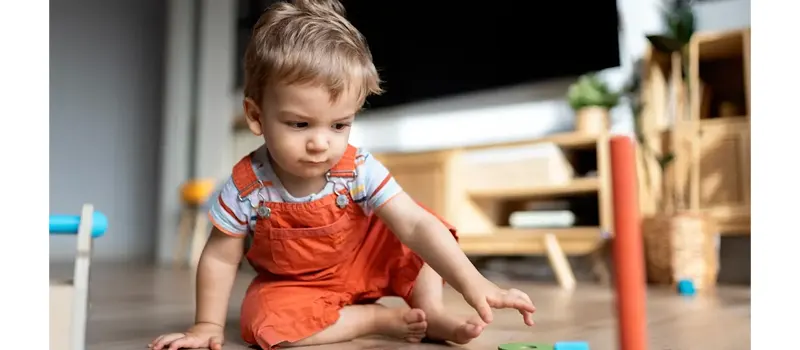
Solitary play is the second stage in Parten’s stages of play and typically emerges between the ages of 2 and 3, though it can appear earlier. In this stage, children engage in play independently, without interacting with or even acknowledging the presence of others nearby. They may be deeply focused on stacking blocks, flipping through a book, or playing with a toy car, showing little interest in what peers are doing around them.
In solitary play, a child might stack blocks, turn pages in a picture book, or explore textures and shapes on their own. The focus is entirely internal, as the child is engaged in self-directed exploration and learning. Solitary play is not a sign of social delay; in fact, it is a healthy and necessary phase of early development. This independent activity allows the child to develop problem-solving skills, build persistence, and gain confidence without the social pressures of group play.
Benefits of Solitary Play
- Promotes independence: Children learn to entertain themselves and make decisions without relying on others for direction or approval.
- Encourages deep concentration: When free from social distractions, children can become fully immersed in their activities, improving focus and attention span.
- Builds confidence and self-regulation: Managing their own play helps children learn how to navigate frustration, success, and boredom on their own terms.
- Stimulates creativity: Solitary play often leads to imaginative thinking, as children invent scenarios, explore ideas, and manipulate toys without outside input.
How to Support Solitary Play?
Teachers and parents can encourage this stage by offering a variety of safe, open-ended materials that invite exploration. Examples include stacking cups, shape sorters, picture books, and simple puzzles. Adults should observe rather than intervene, allowing children to control the pace and direction of their play. A calm, predictable environment helps them feel secure enough to explore independently.
Onlooker Play
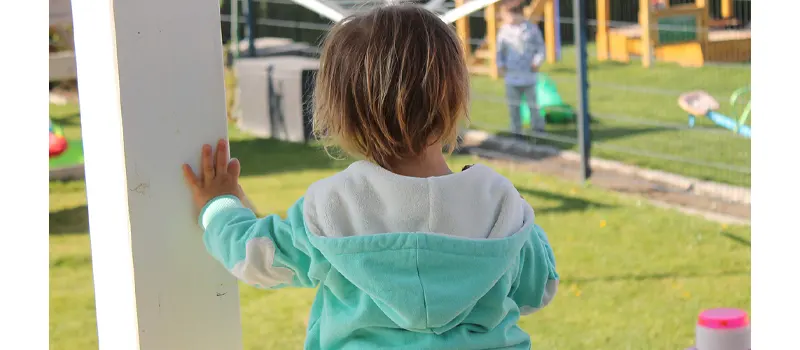
Onlooker play is the third of Parten’s stages of play and often appears around ages 2.5 to 3. During this stage, children do not actively participate in play with others but instead observe their peers from the sidelines. They may watch with great interest, ask questions, or comment on what other children are doing, yet they do not join the activity themselves.
Parents and educators should recognize that onlooker play is not necessarily a sign of shyness or exclusion. It can be a healthy and temporary stage that precedes more active social engagement. Children engaged in onlooker play are absorbing valuable information about how others interact, share, and use toys or materials. This observation helps them understand social cues, group dynamics, and acceptable behaviors within a play setting. It also allows them to gather confidence before entering group play themselves.
Benefits of Onlooker Play
- Supports social learning: Children observe how others interact, share, take turns, and solve conflicts, gaining insight into group behavior.
- Builds language and communication: Asking questions or making comments about observed play encourages vocabulary development and social expression.
- Fosters emotional awareness: Watching other children helps develop empathy and the ability to interpret social cues and body language.
- Reduces anxiety about social interaction: Observing before joining allows more cautious children to feel secure before engaging with peers.
How to Support Onlooker Play?
Educators and parents can gently encourage children at this stage by creating inclusive environments where watching is accepted as part of play. Teachers might narrate what’s happening (“They are building a tower together”) or invite the observer to hand over a block or make a simple suggestion. Having familiar toys and predictable routines helps the child feel secure enough to transition from watching to joining.
Parallel Play
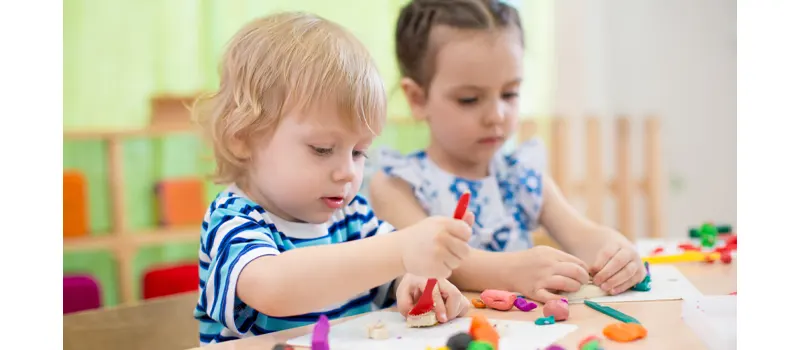
Parallel play is the fourth stage in Parten’s stages of play and typically appears between the ages of 2.5 and 4. In this stage, children play side by side, often using similar toys or engaging in similar activities, but without directly interacting or attempting to influence each other’s behavior. For example, two children might sit next to each other, building with blocks or playing with dolls, but they are each focused on their own creations.
Although it may look like the children are playing independently, parallel play marks a key shift toward social awareness. The child is now comfortable being in the presence of others and may occasionally glance, mimic, or talk aloud, even if no direct interaction occurs. This stage helps children adjust to being part of a group while still maintaining the safety and control of independent play.
Benefits of Parallel Play
- Builds social comfort: Children become accustomed to sharing space with peers, laying the foundation for more cooperative interactions in the future.
- Encourages observation and imitation: While not directly interacting, children learn by watching others and may begin to adopt similar play patterns or language.
- Supports independence with peer exposure: Children retain control over their own play while gradually becoming more socially aware and engaged.
- Promotes early sharing behaviors: Being near others with similar materials introduces the idea of taking turns and respecting personal space.
How to Support Parallel Play?
Educators and parents can foster this stage by setting up shared play spaces with identical or similar materials. Activities like sand play, painting, or building allow children to observe and naturally begin to interact. Adults can model simple social exchanges or encourage turn-taking in a low-pressure way.
Associative Play
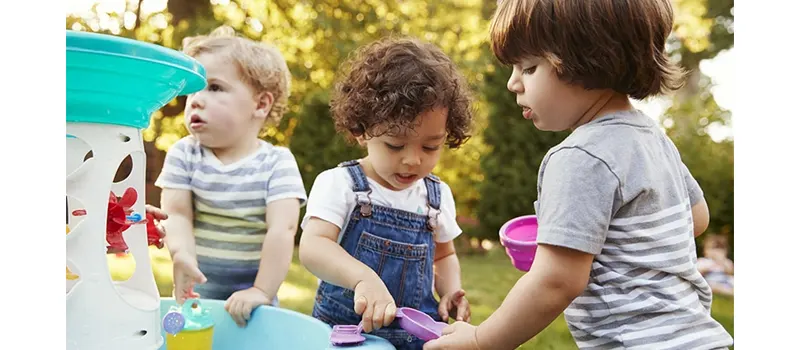
Associative play is the fifth stage in Parten’s stages of play and generally emerges between the ages of 3 and 5. At this stage, children begin to interact more actively with one another during play, though their activities may not yet be fully coordinated. They might share toys, comment on each other’s actions, or loosely work toward a common theme, but there is no fixed organization or shared goal.
For example, a group of children may all be playing in a pretend kitchen, each cooking their own “meal” while occasionally exchanging ingredients or chatting about what they’re making. There’s interaction, but not full collaboration. This phase represents a critical turning point in social development, as children begin to understand the value of communication, friendship, and shared experiences.
Benefits of Associative Play
- Enhances social communication: Children practice listening, speaking, and responding to peers more intentionally.
- Encourages flexibility and imagination: With fewer rules or objectives, children explore creative scenarios together while adapting to others’ ideas.
- Develops early cooperation skills: Although loosely structured, associative play involves turn-taking, compromise, and shared space.
- Strengthens peer relationships: This stage allows children to build early friendships and understand group belonging, even without formal teamwork.
How to Support Associative Play?
Teachers and parents can encourage associative play by offering group-oriented materials like building sets, dress-up clothes, or art supplies that naturally invite sharing and conversation. Adults can model positive communication, introduce simple group rules (“Let’s take turns with the crayons”), and gently guide children toward cooperative interactions without controlling their play.
Cooperative Play
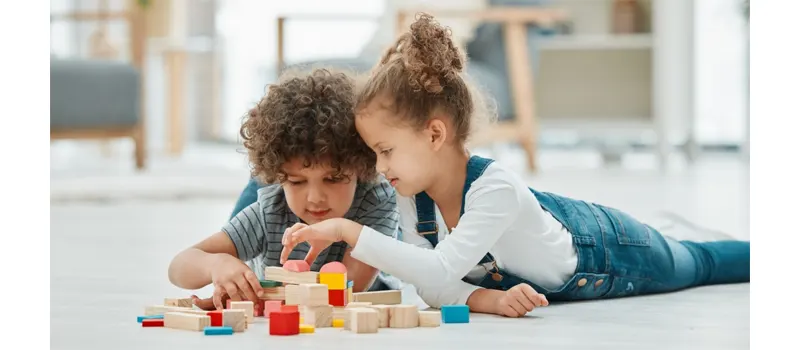
Cooperative play is the final and most socially advanced stage in Parten’s stages of play. It typically appears around age 4 or later and involves children working together toward a shared goal or engaging in structured activities with defined roles. At this stage, children actively communicate, negotiate rules, assign tasks, and collaborate to create complex play scenarios.
Examples of cooperative play include building a fort together, acting out a story as different characters, or playing a game with rules such as hide-and-seek or board games. This kind of play requires children to use higher-level social, emotional, and cognitive skills. They must listen to others, express their own ideas, handle disagreements, and manage group dynamics.
Benefits of Cooperative Play:
- Develops teamwork and collaboration: Children learn how to work with others, share responsibility, and support group goals.
- Builds conflict resolution skills: Disagreements are inevitable in cooperative play, offering valuable opportunities for children to practice negotiation and compromise.
- Strengthens leadership and role awareness: Children take on different roles—leaders, helpers, idea creators—gaining insight into social structure and group function.
- Enhances emotional intelligence: Through group play, children learn empathy, patience, and respect for others’ perspectives and feelings.
How to Support Cooperative Play?
Educators and parents can provide rich opportunities for group projects and imaginative scenarios. Activities like dramatic role-play, building large block structures, or group storytelling encourage children to collaborate naturally. Adults should observe and step in only when needed to help resolve conflicts or model respectful communication. The focus should remain on empowering children to negotiate and cooperate independently.
How Parten’s Theory Supports Modern Early Childhood Practice?
Parten’s stages of play remain a foundational concept in early childhood education, decades after they were first introduced. Her theory offers a clear developmental framework that educators, caregivers, and parents can use to observe, interpret, and support children’s social behavior during play. In modern classrooms and childcare environments, understanding these stages helps guide curriculum planning, classroom design, and interactions that align with children’s social-emotional readiness.
Guiding Observation and Developmental Assessment
In today’s classrooms, observation is a foundational teaching tool. Educators use Parten’s theory to assess social development through play-based behaviors. By noting whether a child is playing alone, watching peers, or engaging cooperatively, teachers can identify developmental milestones and adapt their strategies accordingly. This observational approach makes learning visible and helps track progress over time.
Designing an Inclusive and Responsive Learning Environment
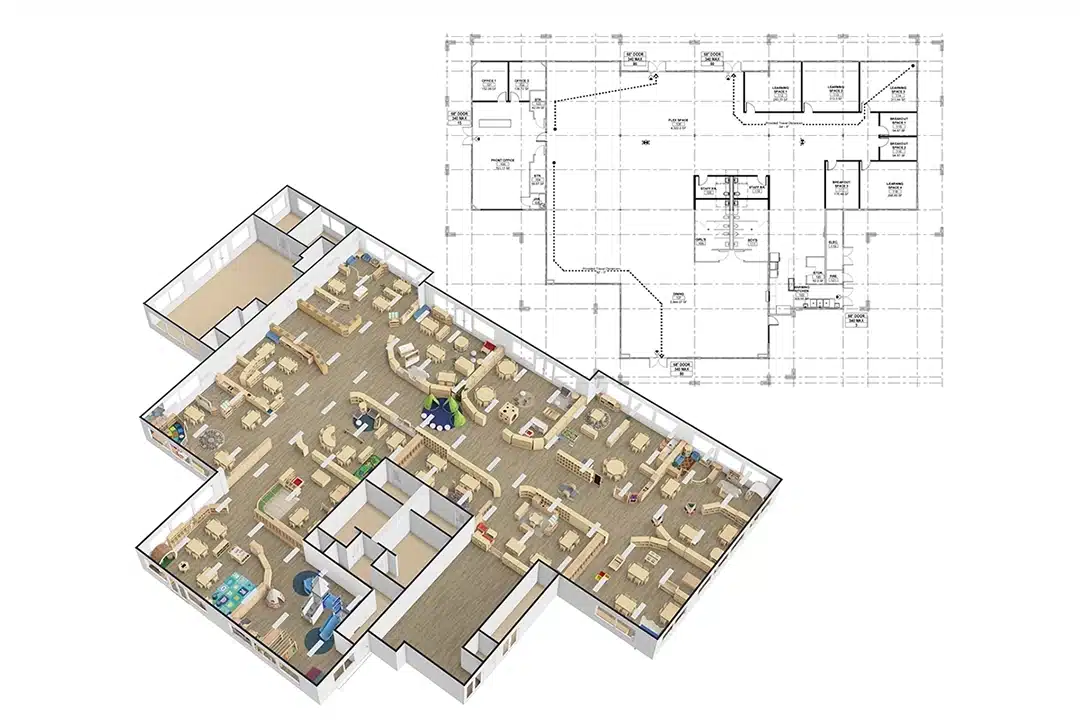
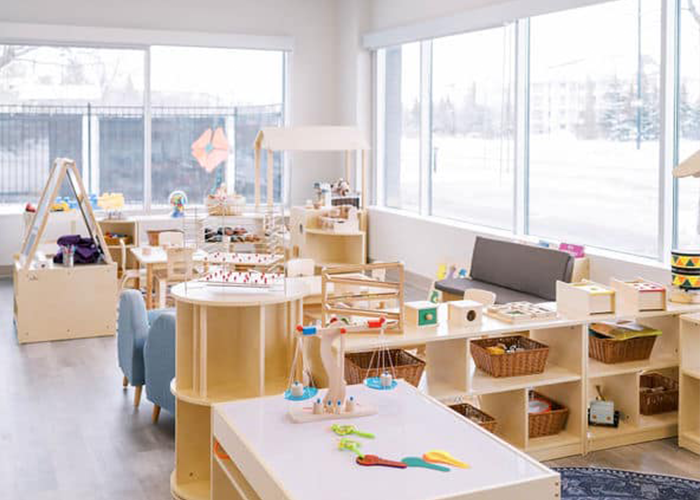
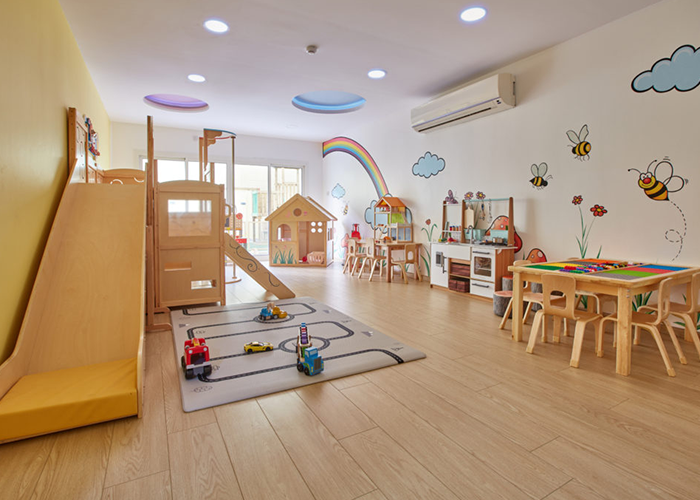
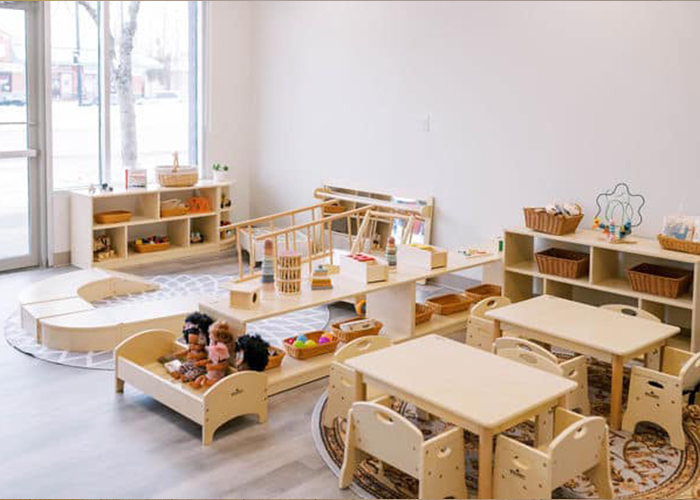
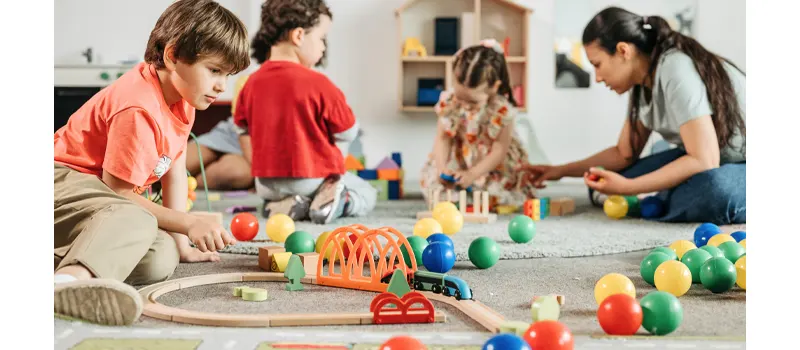
Parten’s stages of play also help shape classroom layout and activity design. Early learning environments are often divided into distinct zones to support different types of play: quiet areas for solitary exploration, shared tables for parallel play, and dramatic play centers that encourage group interaction. This intentional design supports children at various social stages, making the environment both inclusive and developmentally appropriate.
Planning Curriculum That Supports Social Growth
Educators who understand the stages of play intentionally plan learning experiences that promote movement from one stage to the next. For example, a teacher may introduce group storytelling to encourage associative and cooperative play or provide individual art materials to nurture solitary focus. These decisions align play with learning objectives, helping children strengthen communication, collaboration, and emotional regulation.
Empowering Adults to Support Play with Purpose
Finally, Parten’s theory reminds educators and caregivers that play is not a break from learning—it is the learning. Recognizing the value of each play stage encourages adults to engage more meaningfully with children’s behavior, offer the right level of guidance, and appreciate the developmental purpose behind every playful moment.
Conclusion
Parten’s Stages of Play provide one of the clearest and most enduring frameworks for understanding how young children grow socially through play. From unoccupied exploration to cooperative collaboration, each stage reflects meaningful progress in communication, self-awareness, and relationship-building. Recognizing these stages allows teachers and parents to see play not as a random activity but as a structured, purposeful development that prepares children for lifelong learning.
In modern early childhood education, Parten’s theory remains a practical tool for designing inclusive environments, guiding observation, and fostering positive peer relationships. It helps educators adapt classroom strategies to each child’s social readiness, ensuring that every learner feels confident, valued, and supported at their own pace.