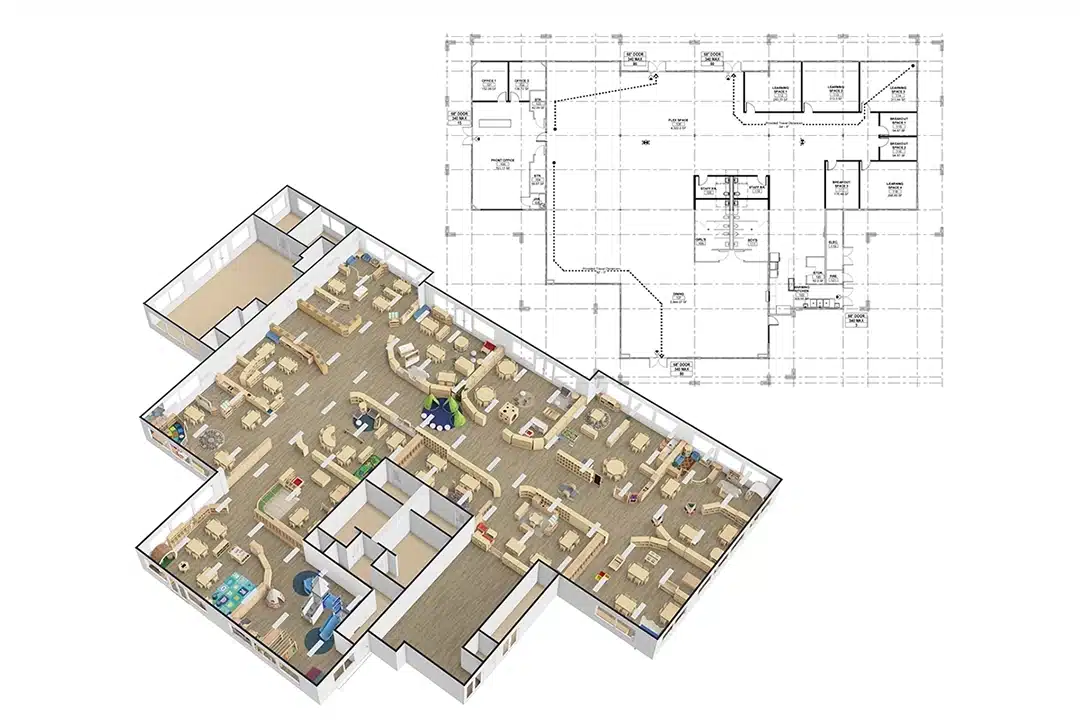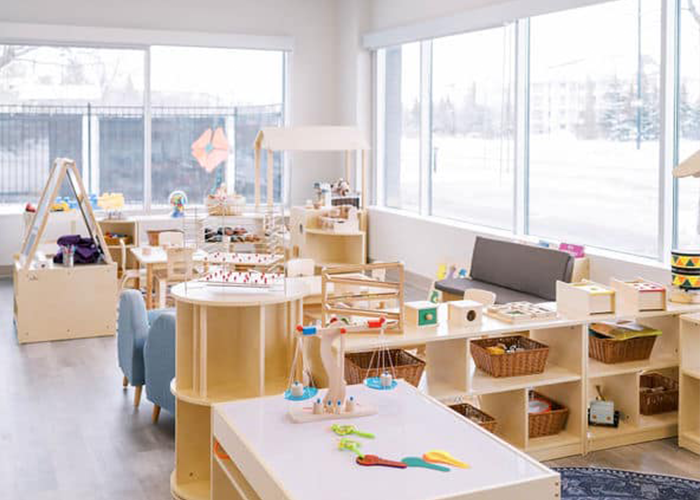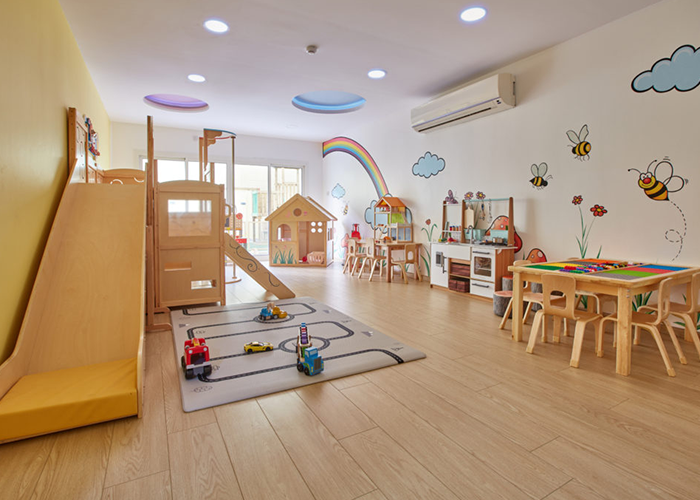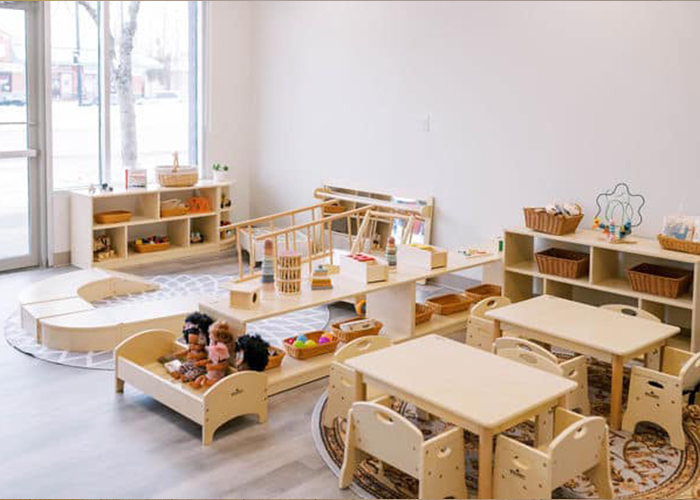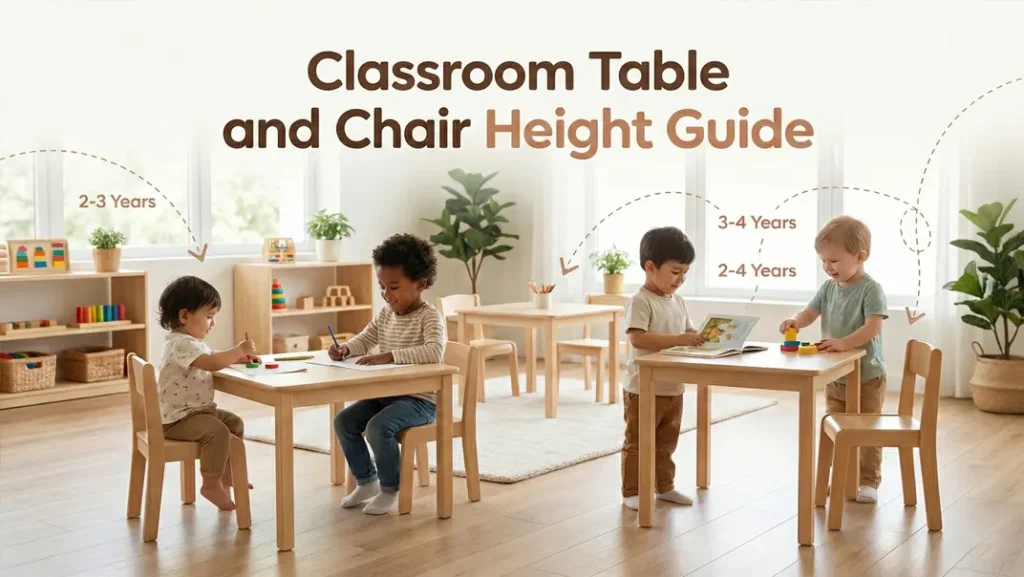
If there is one thing we have learned from executing over 800 educational spaces globally every year, it is this: a chair is never just a chair. When you strip away the aesthetics, classroom furniture is an ecosystem that dictates a child’s posture, focus, and physical development. You can invest in the most beautiful, “Pinterest-worthy” resimercial design, but if a three-year-old’s feet are dangling off the floor, their core muscles will fatigue, leading to fidgeting, distraction, and a disrupted learning environment.
At Xiha Montessori, we don’t just manufacture furniture; we engineer learning solutions. Based on international ergonomic standards (like the EN 1729) and our own data derived from thousands of classrooms across 40 countries, we have compiled the definitive guide to classroom table and chair heights.
This Classroom Table and Chair Height Guide is designed for teachers, center directors, and school buyers who need a reliable way to choose sizes with confidence. You can start with the quick height chart to narrow the options, then use the measurement and on-site checks to confirm the best fit, especially in mixed-age classrooms or spaces that serve multiple activities.
The Ergonomic “90-90-90” Golden Rule
Before consulting any size chart, we need to understand the core standard for judging a child’s sitting posture comfort—the 90-90-90 rule.
When a child is sitting in a chair for reading and writing activities, the ideal posture is:
- Ankles at 90 Degrees: The child’s feet must rest completely and flatly on the floor (they should never be dangling).
- Knees at 90 Degrees: The thigh and calf should form a right angle, with thighs resting flat on the seat. Crucially, there should be a two-to-three-finger gap between the back of the knee and the front edge of the chair to ensure unobstructed blood circulation.
- Elbows at 90 Degrees: When the child drops their arms naturally or rests them on the desktop, the elbows should form an approximate 90-degree angle. The table height should never force them to shrug their shoulders (too high) or hunch over excessively (too low).
Standard Table Dimensions
When people say “standard classroom table size”, they usually mean two things:
- The height of the table from the floor to the top surface
- The length and width of the top, which determine how many students can work comfortably at it
Because children grow quickly, there is no single universal height that suits everyone. Instead, schools generally work with two or three “bands” of standard classroom table height that correspond roughly to age or grade groups.
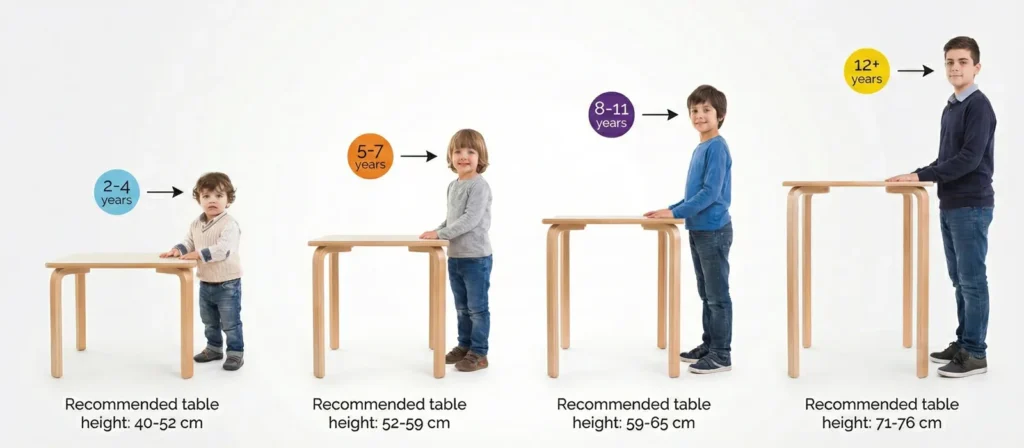
| Age group | Approximate age | Recommended table height (cm) | Notes |
|---|---|---|---|
| Early years / preschool | 2–4 years | 40–52 cm | Low height so children can climb independently and rest forearms easily |
| Lower primary | 5–7 years | 52–59 cm | Supports early writing without forcing children to lean far forward |
| Upper primary | 8–11 years | 59–65 cm | Matches longer legs and arms while keeping a relaxed shoulder posture |
| Secondary / adults | 12+ years | 71–76 cm | Similar to office desk height; suits most teenagers and adults |
Table length and width considerations
Height is only one part of the picture. The working area on top of the table determines how many students can share it without feeling crowded.
Common choices include:
- Single desks (for one student): often around 60–70 cm wide and 45–60 cm deep. These are popular in exam settings or classrooms where independent work and flexible layouts are important.
- Two-student tables: typically 110–130 cm long and 50–60 cm deep. This size allows two students to sit side by side with enough space for books, a laptop or tablet, and writing materials.
- Group tables (trapezoidal, circular, or rectangular clusters): dimensions vary more widely, but the goal is the same: each student should have a personal working area of roughly 60–70 cm in width.
Standard Chair Dimensions
If table height is important, chair dimensions are absolutely critical. The chair is what actually supports the child’s body for hours every day, so small errors here are felt immediately.
Chair dimensions are defined mainly by:
- Seat height: from the floor to the top of the seat
- Seat depth: from the backrest to the front edge of the seat
- Seat width
- Backrest height and shape
For classroom comfort and safety, seat height is the first dimension to get right.
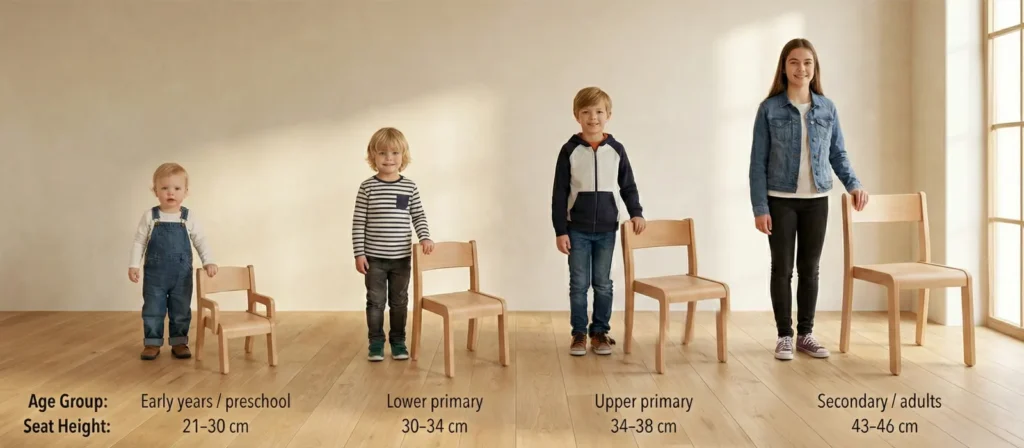
| Age group | Approximate age | Recommended seat height (cm) | Posture goal |
|---|---|---|---|
| Early years / preschool | 2–4 years | 21–30 cm | Feet flat on the floor, easy independent sitting and standing |
| Lower primary | 5–7 years | 30–34 cm | Knees close to 90°, thighs supported without lifting shoulders |
| Upper primary | 8–11 years | 34–38 cm | Allows upright sitting with full back support and relaxed leg position |
| Secondary / adults | 12+ years | 43–46 cm | Standard classroom/office seat height for most teenagers and adults |
Seat depth, backrest and other dimensions
While height gets the most attention, seat depth and back support are just as important for comfort:
- Seat depth should allow the student to sit fully back against the backrest while leaving a small gap (about two or three fingers) between the edge of the seat and the back of the knee. If the seat is too deep, students will slide forward and lose back support; if it is too shallow, the thighs are not properly supported.
- Seat width needs to accommodate the full range of students who will use the chair. Narrow chairs might work in early years, but older students, especially in secondary schools, need enough width to avoid feeling squeezed.
- Backrest height and curvature should support the natural curve of the lower back rather than cutting into the shoulder blades or leaving the lumbar area completely unsupported.
Table and Chair Heights for Different Age Groups
To facilitate rapid decision-making for school administrators, designers, and distributors, we have compiled the following height matrix based on mainstream global standards (including the US BIFMA and the European EN 1729 standard) and combined with our actual implementation data across various continents:
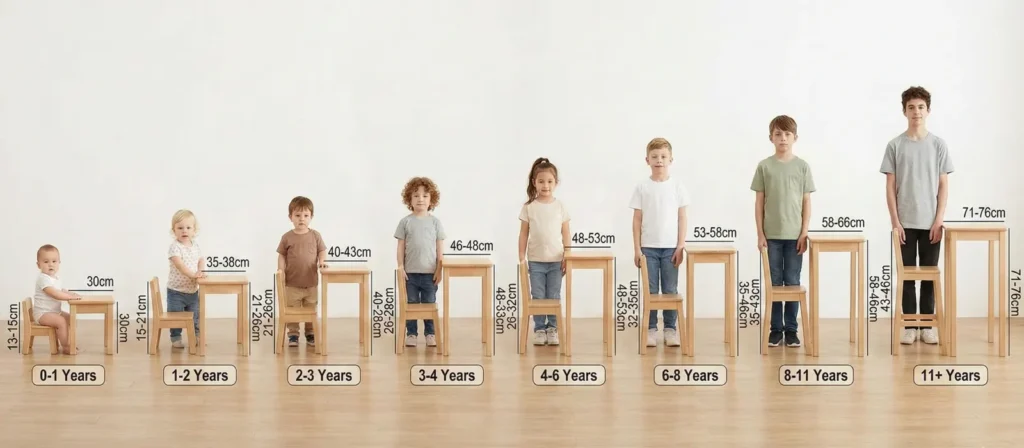
| Age Group | Reference Student Height (cm) | Recommended Chair Seat Height (cm) | Recommended Table Height (cm) | Core Activity Scenario |
| 0 – 1 years | Under 80 | 13 – 15 | 30 | Floor-level sensory exploration, weaning tables |
| 1 – 2 years | 80 – 90 | 15 – 21 | 35 – 38 | Tactile learning, low-level physical interaction |
| 2 – 3 years | 90 – 98 | 21 – 26 | 40 – 43 | Montessori practical life, early art projects |
| 3 – 4 years | 98 – 105 | 26 – 28 | 46 – 48 | Desktop games, fine motor skill development |
| 4 – 6 years | 105 – 120 | 28 – 32 | 48 – 53 | Drawing, early writing, collaborative group work |
| 6 – 8 years | 120 – 135 | 32 – 35 | 53 – 58 | Independent writing, structured classroom learning |
| 8 – 11 years | 135 – 150 | 35 – 43 | 58 – 66 | Deep focus, cross-disciplinary projects |
| 11+ years | 150+ | 43 – 46 | 71 – 76 | Standard academic rigor, extended study periods |
Check out our full range of daycare desks, school chairs, and student desks.
Dimensional Differences Between Tables and Chairs
The relationship between table height and chair height is where everything comes together. You can buy a “standard” table and a “standard” chair, but if the difference between the two is wrong, students still end up working in unhealthy postures.
The ideal height difference: The table top should be approximately 20–30 cm higher than the seat of the chair.
Here is how this looks in practice:
- A preschool chair with a seat height of 26 cm might be paired with a table height of 46–52 cm.
- A lower primary chair with a 32 cm seat height might use a table around 52–59 cm.
- An older primary chair with a 36 cm seat height might match a table at 59–65 cm.
- A secondary chair with a 45 cm seat height usually pairs with a table at 71–76 cm.
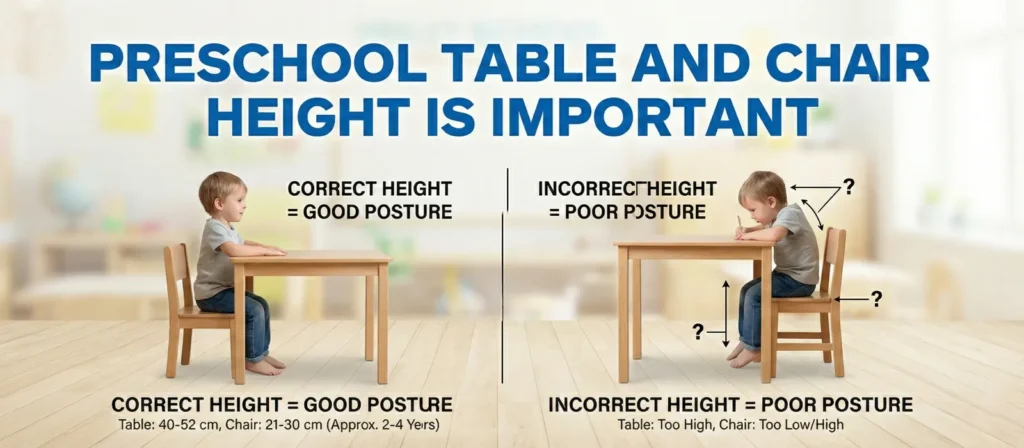
Why Proper Table and Chair Height is Important?
Correct table and chair height might feel like a technical detail for furniture catalogues and facility managers. In reality, it affects almost every aspect of classroom life: attention, behaviour, physical development and even how confident students feel in the learning space.
1. Enhancing Engagement and Concentration
- Correct table and chair height helps students sit comfortably and naturally.
- When the body is supported, students fidget less and can stay focused for longer.
- A stable, comfortable posture makes it easier to read, write and follow instructions.
2. Supporting Healthy Physical Development
- Proper heights keep the spine, hips, knees and ankles in a neutral position.
- This reduces unnecessary strain on growing joints and muscles during long lessons.
- Good sitting habits formed at school can carry over into later study and work.
3. Fostering Confidence and Creativity
- Furniture that fits the student’s body makes the classroom feel welcoming and “made for them”.
- Children can move, reach materials and participate without struggling with the furniture itself.
- When students feel physically comfortable and secure, they are more willing to speak, share ideas and try new tasks.
Introduction to BS EN1729
If you have browsed school furniture catalogues in Europe or from international manufacturers, you have probably seen references such as “BS EN1729 Size 4 chair” or “Table – Size 5, EN1729 compliant”. Understanding this standard will make your purchasing decisions much easier.
BS EN1729 is a European standard specifically created for chairs and tables used in educational institutions. It has two main parts:
- Part 1: defines functional dimensions – in other words, how high the seat should be, how high the table should be, how deep the seat should be, and so on, for different sizes of user.
- Part 2: covers safety and structural requirements, such as stability, strength and durability.
For anyone responsible for choosing classroom furniture, Part 1 is especially relevant because it translates ergonomic research into practical, repeatable sizes.
Matching Height to Substance
A 35cm toddler table and a 76cm high-school desk cannot be built exactly the same way. The taller the leg, the higher the leverage and stress on the joints. We orchestrate our materials to fit the zone and the height:
- For Early Childhood (Low Heights): We heavily integrate Solid Beech and Rubberwood for legs and touchpoints. At these lower heights, the structural load is smaller, and the tactile, warm sensation of solid wood provides sensory comfort for young learners.
- For Primary to High School (Tall Heights): We rely on 11-ply Premium Birch Plywood for table cores and structural panels. Solid wood expands and contracts with AC/heating fluctuations, which can cause tall tables to warp or wobble over time. Engineered 11-ply Birch offers unparalleled cross-laminated strength, ensuring a rock-solid work surface year after year.
- For Outdoor Classrooms: Wood degrades when exposed to constant moisture. We pivot to Carbonized Acacia or Recycled HDPE, giving schools a sustainable, weather-proof solution without compromising the ergonomic heights listed above.
FAQs
- Is there one “standard” classroom table and chair height that works for everyone?
No. A single classroom table and chair height cannot fit preschoolers and teenagers at the same time. Even within one grade, student height varies a lot. It’s better to use at least two or three size groups across a school, or to combine fixed chairs with a range of table heights. - How do I quickly check if a table and chair height is wrong for a student?
Ask the student to sit naturally. If feet can’t rest flat on the floor, the chair is too high. If knees are much higher than hips, it’s too low. If shoulders lift or elbows are forced up when writing, the table is too high; if they hunch forward to reach their work, it’s too low. These quick checks work in real classrooms far better than guessing from catalogues. - Is it worth paying extra for height-adjustable desks?
Height-adjustable desks are most valuable in shared spaces and in schools where classroom allocation changes frequently. They let you adapt classroom table and chair height over time, instead of replacing furniture. For stable, single-grade rooms, fixed-height furniture is often cost-effective if you choose the right size from the start. - Should I choose desks by age or by student height?
Height is more reliable. Age groups can include very different body sizes, especially during growth spurts. - How often should we re-check furniture fit?
At least annually, and ideally mid-year for grades with rapid growth. Small adjustments or seat swaps can make a big difference.
Turn Your Height Guide into a Better Classroom
You now have a clear, practical framework for choosing classroom table and chair height: understand your students, use standards wisely, and test in the real classroom.
- Start by mapping out your classes and age groups.
- Shortlist two or three size combinations for each space.
- Talk to your supplier about EN 1729 compliance and height-adjustable options.
- Run a small pilot, adjust, and then roll out with confidence.
If you’re preparing a new build, refurbishing old rooms, or helping a client choose furniture, treat classroom table and chair height as a design decision.
Xiha Montessori balances the warm aesthetics of the classroom environment with the robust durability required for institutional use, ensuring that every piece of furniture supports the teaching philosophy.
When classroom table and chair height is right, you don’t hear about it. Students simply sit down, feel comfortable, and get on with learning. That quiet success is exactly what you’re aiming for.