Playground safety rules are fundamental guidelines designed to help reduce accidental injuries during outdoor play in schools and childcare centers. These rules remind children to “be careful” and guide them in a clear, repeatable way as they move, interact, and use equipment in shared spaces. When these rules are simple, easy to understand, and consistently reinforced, they can effectively prevent many common playground accidents, such as falls, collisions, and misuse of equipment.
This guide highlights the most important playground safety rules for schools and childcare centers. It explains the key rules children should follow, supervisory guidelines for administrators, and how teachers and caregivers can instill these rules into daily routines to support safer and more confident play.
Why Playground Safety Rules Matter in Educational Settings?
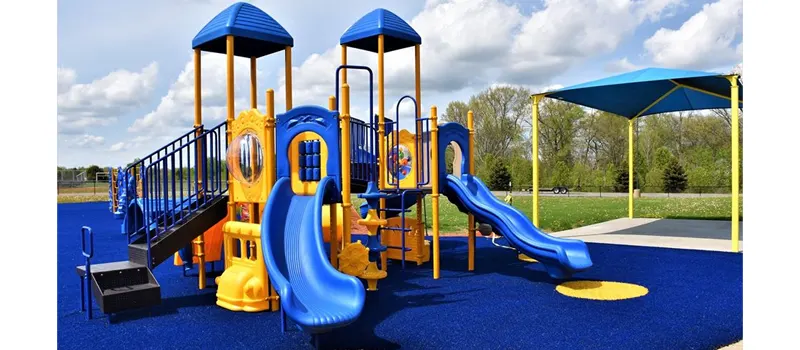
Playground safety rules are essential in educational settings because most injuries are linked to behavior rather than equipment. When children run through swing zones, crowd platforms, or use equipment incorrectly, the risk of falls and collisions increases significantly.
It gets more complicated once you have a full group outside. The movement harder to predict and control. Mixed-age use adds further risk. Younger children may attempt equipment beyond their ability, while older children tend to move faster and take more chances.
Clear and consistent rules help bring structure to this environment. Simple expectations such as waiting for a turn, using equipment as intended, and keeping clear of active play zones make behavior more predictable and easier to manage.
On a busy playground, staff can’t step in every time something starts to go wrong. Good rules reduce how often they need to. Over time, children get used to those boundaries, and you see fewer unsafe situations without having to correct everything in the moment.
Notice:
- Playground safety rules cannot replace the need for high-quality, age-appropriate equipment.
- Rules cannot replace active and attentive supervision.
- Rules also cannot replace regular inspection and maintenance of the playground.
14 Playground Safety Rules for Children
Playground safety rules for children should be simple, specific, and easy to remember. Young children do not respond well to vague reminders like “be careful,” because those words do not tell them what to do. Clear rules work better when they describe a visible action, such as waiting for a turn or staying clear of swings. In schools and childcare centers, the most effective playground safety rules are the ones children can understand quickly, and adults can reinforce consistently during everyday play.
1. Take Turns
Teach children to wait patiently before using playground equipment. Rushing or pushing ahead can lead to crowding, especially on ladders and slides, increasing the risk of falls and collisions.
2. No Pushing or Rough Play
Remind children to keep their hands to themselves. Pushing, shoving, or play fighting can quickly cause someone to lose balance, especially on elevated platforms or near moving equipment.
3. Use Equipment the Right Way
Children should use each piece of equipment as it is designed. For example, slides are meant for going down feet first, and swings should be used while sitting. Using equipment the wrong way can lead to unexpected accidents.
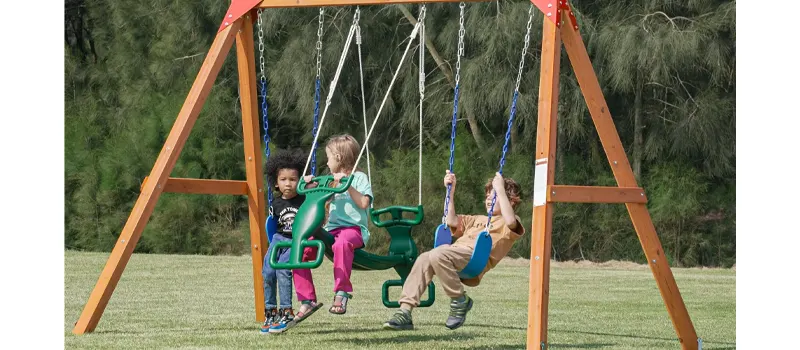
4. Stay Clear of Swings and Moving Equipment
Teach children to stay away from the front and back of swings or any moving equipment. Walking or running through these areas can result in being hit and knocked down.
5. Do Not Climb Up Slides
Encourage children to use slides only for going down. Climbing up the slide can cause collisions with others coming down and increase the risk of slipping.
6. One at a Time on Ladders and Climbers
Children should avoid crowding when climbing. Taking turns on ladders and climbing structures helps maintain balance and prevents others from being pushed or blocked.
7. Hold On When Climbing
Teach children to always hold on with both hands when using climbers, monkey bars, or ladders. A firm grip helps maintain control and reduces the chance of falling.
8. Be Mindful of Surroundings
Children should stay aware of other children playing nearby. Being mindful of others helps prevent accidental bumps, especially in busy playground areas.
9. Stay Off Wet or Damaged Equipment
Children should avoid using equipment that is wet, broken, or unstable. Slippery surfaces or damaged parts can easily cause falls or injuries.
10. Wear Proper Shoes
Make sure children wear well-fitting shoes with a good grip. Loose or inappropriate footwear can cause slipping or make it harder to climb safely.
11. Keep the Slide Exit Clear
Teach children to move away quickly after going down a slide. Staying at the bottom can cause others to land on them, leading to avoidable injuries.
12. Wear Appropriate Clothing
Children should wear clothing that allows them to move safely. Avoid loose items like scarves, strings, or accessories that could get caught in equipment.
13. Look Before Using Equipment
Encourage children to check before they use equipment. They should make sure no one is already on a slide, inside a tunnel, or in the landing area to avoid collisions.
14. Tell an Adult if Something Is Unsafe
Encourage children to speak up if they notice anything unsafe, such as broken equipment or dangerous behavior. Reporting problems early helps prevent accidents.
9 Playground Safety Rules for Teachers and Supervisors
Teachers and supervisors also need clear playground safety rules to follow, because the overall safety of the playground depends on how consistently adults manage, observe, and respond to what is happening. When staff follow a defined set of practices, supervision becomes more structured, and risks are easier to control.
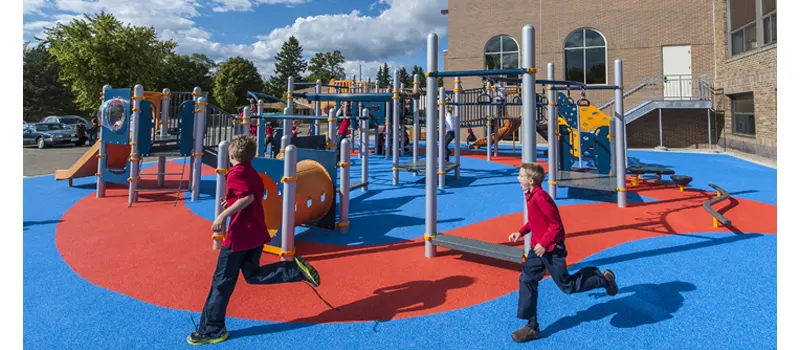
1. Be Present and Actively Supervising at All Times
Supervisors should remain fully focused on the playground while children are outside. Distractions such as phones, conversations, or multitasking can reduce awareness and delay response to unsafe situations.
2. Position Yourself to See High-Risk Areas
Staff should stand where they can clearly see key areas such as swing paths, slide exits, and climbing structures. Poor positioning can create blind spots where unsafe behavior goes unnoticed.
3. Enforce Rules Consistently
All staff should apply the same playground rules in the same way. Inconsistent enforcement can confuse children and lead to repeated unsafe behavior.
4. Intervene Early, Not After an Incident
Supervisors should step in when they see behavior becoming unsafe, not only after someone gets hurt. Early intervention helps prevent accidents before they happen.
5. Limit Overcrowding in Key Areas
Teachers should monitor how many children are using a piece of equipment at one time. If an area becomes too crowded, it should be managed or redirected to maintain safe use.


6. Check the Playground Before Use
Before children begin playing, staff should do a quick visual check of the equipment and surface conditions, including wet areas, obstacles, or visible damage.
7. Stop Use of Unsafe Equipment Immediately
If any equipment appears broken, unstable, or unsafe, it should be taken out of use right away until it is fixed. Children should not be allowed to continue using it.
8. Maintain Clear Communication Among Staff
Supervisors should stay aware of each other’s positions and coordinate when needed. Good communication helps ensure all areas are properly covered.
9. Respond to Incidents and Report Them Properly
Any injury, unsafe condition, or repeated rule violation should be addressed and reported according to the center’s procedures. Proper reporting helps improve safety over time.
Equipment-Specific Safety Rules
Different types of playground equipment require different safety rules. In real use, many injuries happen because children treat every structure the same way, moving too fast, ignoring spacing, or using equipment incorrectly. Clear, equipment-specific rules help reduce these risks and make supervision more consistent.
Slides
Slides tend to get crowded very quickly, especially during busy periods. Most problems happen at the top platform and the exit area, where children lose awareness of spacing or try to move too fast. Without clear rules, it often leads to collisions at the bottom or pushing at the top.
Playground Safety Rules for Children:
- Go down feet first
- One at a time
- Wait until the bottom is clear
- Do not climb up the slide
Swings
Swing areas are one of the hardest zones to manage because children naturally pass through them when moving around the playground. Many incidents happen not on the swing itself, but when a child walks into the path of a moving seat.
Playground Safety Rules for Children:
- Sit down and hold on
- Do not stand or twist
- Stay away from moving swings
- Walk around, not through, the swing area
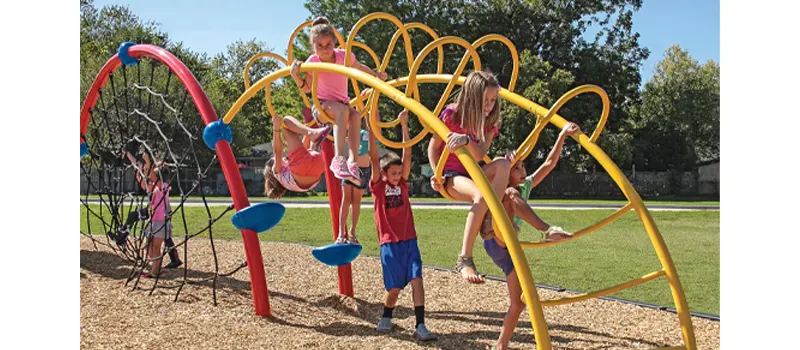
Climbers
Climbing structures often become unsafe when children start rushing or competing for space. Teachers will usually notice pushing from below, children trying to pass each other, or climbing beyond the intended height.
Playground Safety Rules for Children:
- Use both hands
- Move one step at a time
- Do not push or pass others
- Do not climb above the rails
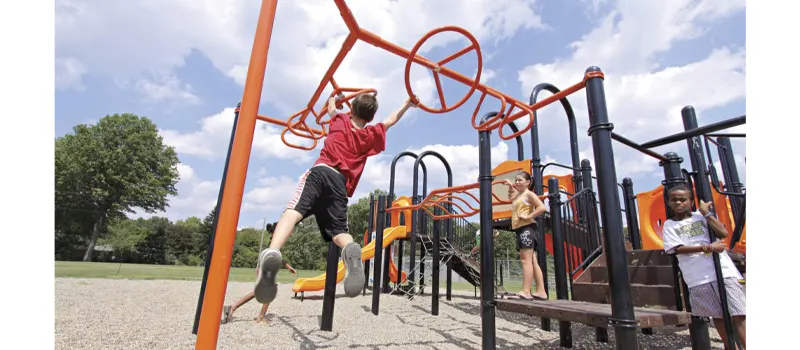
Monkey Bars and Overhead Climbers
Overhead equipment is where children tend to test their limits. The risk increases when they try to use it before they have the strength to support themselves or when other children gather underneath.
Playground Safety Rules for Children:
- Move one bar at a time
- Hold on with both hands
- Only use if you can reach and hold
- Do not stand underneath others
Spinners and Merry-Go-Rounds
These areas can get out of control quickly when children focus on speed instead of balance. Teachers often see children trying to jump off or others pushing too hard from the outside.
Playground Safety Rules for Children:
- Hold on tightly
- Sit or stand properly
- Do not get on or off while moving
- Do not push too fast
Seesaws and Spring Riders
Even though these are closer to the ground, they still require control. Problems usually come from overcrowding or children using force instead of balance.
Playground Safety Rules for Children:
- Sit properly and hold on
- Keep movement gentle
- Do not overcrowd
- Keep feet clear when moving
Tunnels
Tunnels reduce visibility, which makes it harder for staff to see what is happening inside. Children often rush in without checking or stop in the middle, which leads to small but frequent collisions.
Playground Safety Rules for Children:
- Look before going in
- Move through without stopping
- Do not push
- Wait, if someone is inside
Balance Equipment
Balance equipment is often used like a race, especially in group settings. When children move too fast, they lose the control that the equipment is designed to provide.
Playground Safety Rules for Children:
- Go one at a time if needed
- Walk, do not run
- Step down carefully
- Do not jump off from a height
Platforms and Guardrails
Platforms are transition areas, but children often turn them into play spaces. This is where teachers start to see climbing on rails, leaning over edges, or crowding in a limited space.
Playground Safety Rules for Children:
- Stay behind the rails
- Do not climb or sit on barriers
- Keep space for others
- Wait calmly for your turn
Moving Between Equipment
One of the most overlooked risks is how children move between structures. In busy playgrounds, many incidents happen when children run between areas, cut through active zones, or don’t watch where they are going.
Playground Safety Rules for Children:
- Walk, do not run
- Stay clear of slide exits
- Do not walk through swing areas
- Watch where you are going
How to Teach Playground Safety Rules Effectively?
For playground safety rules to be truly effective, children need to understand, remember, and apply these rules while playing. This requires using simple language, consistent reinforcement, and clearly linking the rules to real-world situations on the playground.
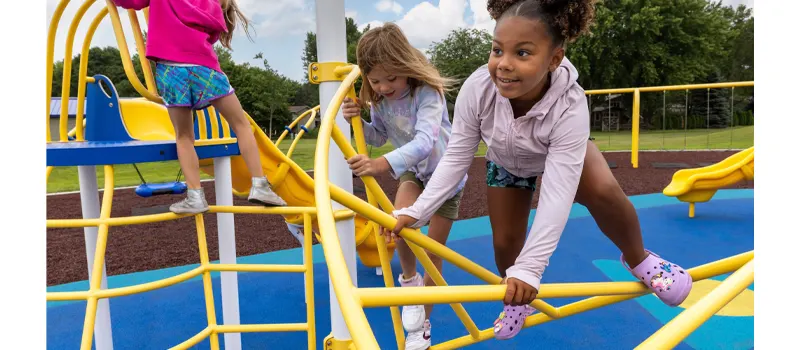
Keep Rules Simple and Specific
Children respond better to clear instructions. Instead of saying “be careful,” use direct phrases like “stay clear of swings.” Specific rules are easier to understand and follow.
Introduce Rules Before Play Begins
Rules are more effective when children hear them before they start playing. A short reminder at the beginning of outdoor play helps set expectations and reduces the need for constant correction later.
Use Repetition to Build a Habit
Children learn through repetition. When the same rules are reinforced daily, they become familiar and easier to follow without reminders.
Connect Rules to Real Situations
When correcting behavior, explain why the rule matters. Seize those teachable moments. If a child runs through the swing area, pull them safely to the side, point to the swinging seat, and ask: “If those shoes hit your head right now, how would that feel?” Connecting rules to physical consequences is far more convincing than a standard time-out.
Be Consistent Across All Staff
All teachers and supervisors should use the same rules and language. Consistency helps children recognize patterns and reduces confusion.
Model the Right Behavior
Children often learn by watching adults. Demonstrating safe ways to use equipment can be more effective than repeated verbal instructions.
Reinforce Positive Behavior
Recognizing safe behavior encourages children to repeat it. Shift half your energy from correcting to praising. Project a loud, specific encouragement: “I absolutely love how Leo is waiting patiently behind the red line for his turn.” Watch how quickly the others adjust their behavior to get that same spotlight.
Adjust Teaching Based on Age
Younger children need shorter, simpler rules and more frequent reminders. Older children can handle more explanation and are better able to understand responsibility and consequences.
Balancing Safety with “Healthy Risk”
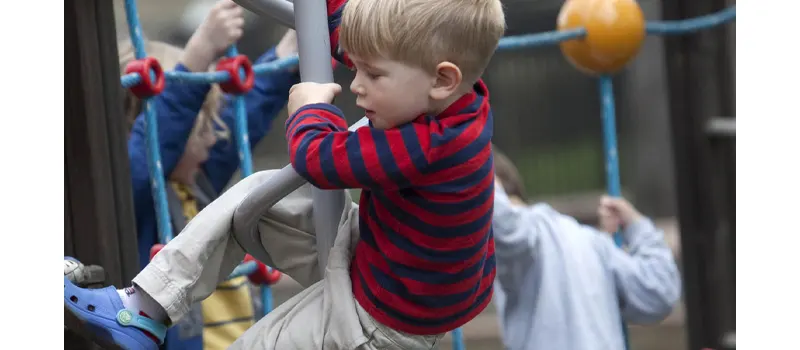
Children need opportunities to build judgment, body control, and confidence, and those things do not develop in flat, overly restricted spaces. They develop when children can try, assess, adjust, and improve. Safety rules are not meant to eliminate challenges, but rather to control the difficulty of those challenges.
What matters in practice is knowing where to allow challenge and where to step in. A child slowing down to cross a balance element, reaching carefully on a climber, or deciding whether they are ready for a piece of equipment is experiencing a healthy level of challenge. A child climbing on top of a guardrail, jumping from a height, or rushing through crowded equipment is in a very different situation. That is where staff need to step in.
We have also found that the physical setup of the playground directly affects how well these rules work. Good playground equipment does not remove challenge, but it supports it more safely. When equipment is age-appropriate, properly spaced, and designed with clear entry and exit points, children are more likely to follow expected movement patterns. This makes it easier for rules to be understood and applied in real time.
In the end, balancing safety with healthy risk is not about limiting play. It is about using clear rules and well-designed environments to keep that play active, while reducing the behaviors that most often lead to preventable injuries.
Conclusion
Playground safety rules are most effective when they are clear, consistent, and integrated into daily practice. When children understand the rules and hear the same instructions every day, safety habits will naturally become part of their play. At the same time, rules also require responsible supervision and a well-managed environment.
Please remember that safety doesn’t mean eliminating risk. Children need opportunities to challenge themselves. Playground safety rules serve to guide these experiences, keeping them within appropriate and controlled limits while promoting child development. From a planning perspective, this balance is easier to achieve if the playground is designed with safety and child development in mind.
If you are planning or upgrading a playground, we can help design a safer, more manageable layout and provide equipment that matches different age groups. The goal create a safe space where children can move, explore, and grow with confidence.
FAQs
How many playground safety rules should schools or childcare centers have?
There is no fixed number, but most schools and childcare centers use a short set of clear rules, usually between 8 and 14. Too many rules can be hard for children to remember, while too few may not cover key safety situations.
How can teachers help children remember playground rules?
Consistency is key. Teachers can reinforce rules by repeating them daily, using simple language, and correcting behavior in the moment. Over time, children begin to follow the rules as part of their routine.
How often should playground safety rules be reviewed with children?
Rules should be reinforced regularly rather than taught once. Short reminders before outdoor play, combined with consistent correction during playtime, are usually more effective than occasional formal instruction.
Do playground safety rules change for different age groups?
Yes, rules should be adapted based on children’s physical ability and behavior. Younger children often need more guidance on basic movement and spacing, while older children may need clearer limits around speed, height, and risk-taking.
What should we consider when planning a new school or daycare playground?
It helps to think beyond individual pieces of equipment and focus on the overall layout. Key considerations include age zoning, traffic flow between structures, visibility for supervision, and spacing around high-use areas. A well-planned layout reduces crowding and makes it easier for children to follow safety rules in daily use.
Can playground design reduce the need for constant supervision?
Good design does not replace supervision, but it can make it more effective. When equipment is arranged with clear movement paths, defined activity zones, and fewer conflict points, children naturally move in safer patterns. This reduces the number of situations where staff need to step in repeatedly.