When you buy cribs for a daycare, you need clear answers to four questions: which type suits the children, how many fit the room, what safety documents do you need, and how will staff clean and inspect them? Use this guide to compare crib types, mattress fit, safety records, room layout, materials, and supplier quotes before you place an order.
Why daycare cribs need careful planning
Daycare cribs are used by several children and caregivers every day. Staff need to reach each crib, see the sleeping area, change bedding, and complete routine checks without moving other furniture. The cribs also need to stand up to frequent cleaning and repeated assembly or adjustment.
For that reason, choose the crib together with the room layout and daily routine. A crib can look suitable in a product photo and still create problems if the mattress is hard to replace, the hardware is difficult to inspect, or the room becomes too crowded.
Decide what your room needs
Start with the conditions in your own facility. This will give you a useful specification before you compare products.
Match the cribs to the children
Confirm the age range and developmental stage first. A room for young infants may need a different access height and supervision arrangement from a room for older infants who can sit or pull to stand.
If the room will serve more than one age group, ask whether one crib configuration can cover the full period of use. Do not change the crib or mattress to extend its use unless the manufacturer and your local licensing authority allow that configuration.
Use the supplier’s age or weight information as a starting point. Your local childcare rules decide whether the product is acceptable for your facility.
Count the cribs your room can actually fit
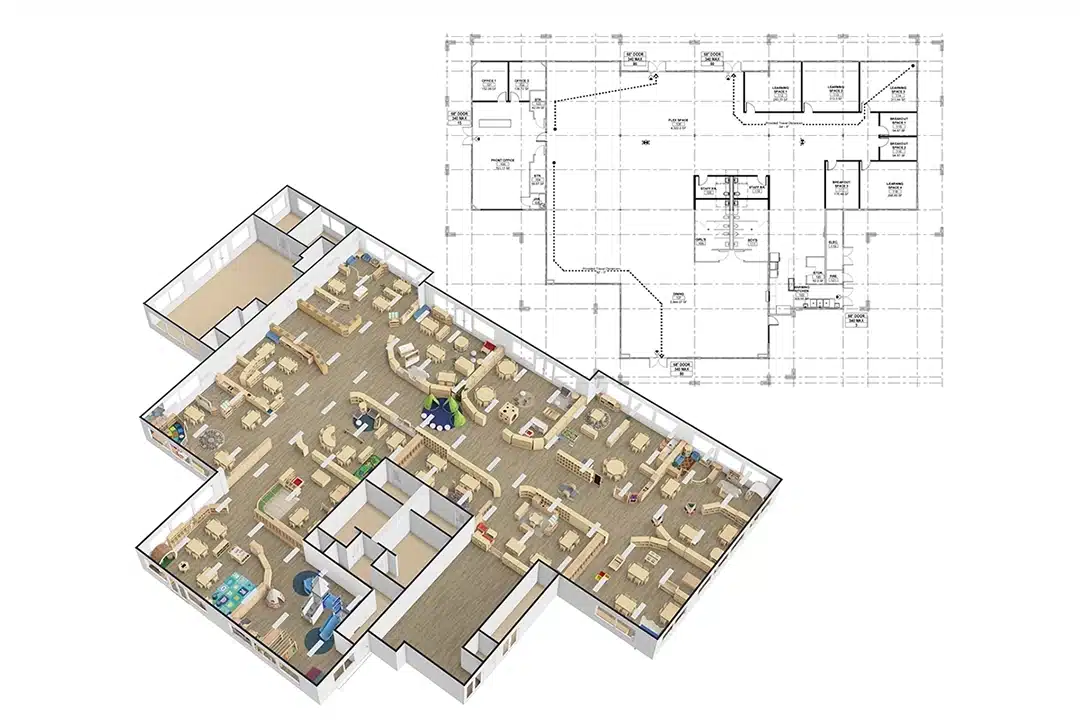
Measure the room before you decide how many cribs to order. Mark the door, exits, windows, heaters, outlets, sinks, changing area, storage, and fixed equipment. Then place the crib footprints on a scaled plan.
Leave room for:
- staff to reach each crib;
- clear sightlines across the sleep area;
- clean linen storage and a route for soiled items;
- the door and any required exit path;
- future changes in enrollment or room use.
If cribs share space with feeding, changing, or play activities, define the sleep area first. Do not fill every open corner and expect staff to solve the circulation problem later.
Think about daily use
Ask your team what happens during a normal nap period. Who puts infants down? Where are clean sheets stored? How does a caregiver remove a soiled mattress? Can one staff member reach the farthest crib while another is feeding a baby?
These questions help you choose between a fixed crib, a compact model, or a model with casters. The best option is the one your staff can use consistently without extra handling steps.
If you are comparing infant cribs with sleep furniture for older children, see this guide to cribs and cots for childcare settings.
Choose the right crib type
Use this table to narrow your options. The final choice still depends on local rules, room dimensions, and the documentation available for the exact model.
| Crib type or feature | A good fit when | Check before you buy |
|---|---|---|
| Full-size crib | You have a dedicated infant room and enough floor space | Interior dimensions, applicable standard, mattress model, and replacement parts |
| Compact crib | The room is small or the layout requires a smaller footprint | Product classification, compatible mattress, local approval, and long-term availability |
| Fixed-side crib | You want one stable setup for daily use | Staff access, side height, locking details, and permitted configuration |
| Clear-view crib | Staff need a better view of the infant sleep area | Panel cleaning, scratch resistance, hardware, and a layout that still supports active supervision |
| Crib with casters | You have a clear reason to move the crib during room changes | Wheel locks, stability, floor transitions, and the facility’s moving procedure |
Terms such as “commercial” or “daycare” describe the intended market. They do not replace safety documents or local approval. Ask the supplier to show the evidence for the exact model and configuration.
Check safety and compliance
Start with the rules that apply to your market. For a U.S. project, the Consumer Product Safety Commission’s full-size baby crib guidance covers cribs intended for use in child care facilities. The guidance includes requirements for dimensions, slats, hardware, labeling, testing, and crib-side performance.
Ask the supplier which standard and version apply to the model you are considering. For a U.S. project, ask how the supplier will provide the Children’s Product Certificate (CPC), test reports, tracking information, and product registration materials. For another country, use the certification and licensing system required by that market.
Request documents for the actual product, not a general factory statement. Your file should include:
- manufacturer, importer, model number, and date-of-manufacture information;
- the applicable standard and supporting test or certification documents;
- assembly instructions and a complete hardware list;
- warnings, labels, tracking information, and registration instructions;
- the process for recalls, replacement parts, and safety notices.
Do not use a crib with missing instructions, substituted hardware, repaired sides, drilled holes, or unknown modifications until the product’s condition and compliance have been confirmed.
Choose the right mattress
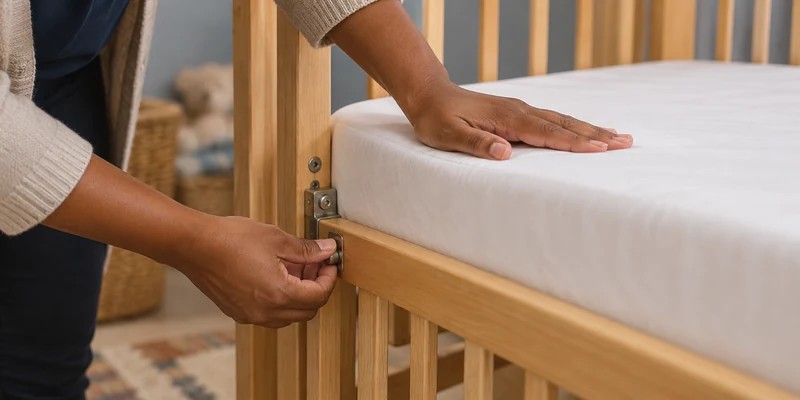
The mattress must match the crib. It should be firm, flat, and held in place without a dangerous gap. The CPSC crib mattress FAQ explains the requirements related to mattress dimensions, firmness, thickness, compatibility, and labeling.
When a crib is sold without a mattress, ask for the exact compatible mattress model. Do not choose a replacement only because its measurements look correct. The crib and mattress may need to be tested together.
Also ask how the mattress cover should be cleaned, whether replacement covers are available, and how moisture is handled. Remove any mattress that is torn, wet, misshapen, or no longer fits tightly.
The American Academy of Pediatrics safe-sleep guidance recommends a firm, flat sleep surface, a tightly fitted mattress, and no loose objects or soft bedding in the crib. Follow your written center policy and local rules for daily sleep practices.
Choose materials that are easy to clean
Inspect the areas that are difficult to see in a product photo: corners, joints, fasteners, the mattress support, and the underside of the frame. These areas collect moisture and residue when the crib is used every day.
Look for:
- smooth surfaces that staff can wipe without deep grooves;
- rounded edges and no exposed sharp points;
- joints that stay tight after repeated use;
- hardware that staff can inspect and tighten as instructed;
- a finish that works with your approved cleaning products;
- replacement parts that can be ordered separately.
Wood, coated metal, composite panels, and clear-view parts each have different cleaning, repair, weight, and appearance considerations. In classroom planning, we review those details together. A material is suitable when your staff can clean, inspect, move, and repair it without adding a difficult procedure to the daily routine.
You can also review this guide to daycare furniture materials, then ask the crib supplier for care instructions for the exact model and finish.
Plan the room before you order
Place the cribs on a scaled floor plan before you approve the quantity. Test the layout from a caregiver’s point of view.
Check five things:
- Sightlines: Can staff see every sleeping infant from their normal work positions?
- Access: Can a caregiver reach each crib without stepping over another crib or moving equipment?
- Exit paths: Are the door and required exit routes clear at all times?
- Cleaning flow: Can clean sheets enter and soiled items leave without crossing the sleep area unnecessarily?
- Future changes: Can you add or remove one crib without rebuilding the whole room?
Clear-view sides can help with visibility, but they cannot fix a blocked layout. Casters can help with planned room changes, but they do not replace an evacuation procedure.
The daycare floor plan guide gives you a starting point for circulation and functional zones. Your building, fire, accessibility, and childcare requirements still control the final layout.

What to ask a crib supplier
Ask every supplier to quote the same specification. A unit price is difficult to compare when one quote includes the mattress, documents, spare hardware, packing, or delivery and another does not.
| Question | Why it matters | What to request |
|---|---|---|
| What is the exact model and configuration? | Similar photos can hide different dimensions and hardware | Model number, drawing, specification sheet, and current photos |
| Which standard applies? | “Daycare” is not a certification | Standard and version, test reports, CPC or local equivalent |
| Which mattress fits? | Mattress fit is part of safe use | Mattress model, compatibility statement, and replacement option |
| What are the material and finish? | Cleaning and repair depend on construction details | Material, coating, care instructions, and sample if needed |
| What happens after delivery? | Missing parts or damage can delay room opening | Packing method, receiving inspection, spare-parts policy, and warranty |
| Can you supply the same model later? | Mixed models create different staff and maintenance procedures | Model continuity, lead time, MOQ, and change-notification process |
| What can be customized? | A custom size may affect testing and documentation | Drawing approval, change list, revised documents, and certification limits |
If a supplier cannot answer these questions before you order, the same uncertainty will remain after shipment. Compare compliance support, maintenance, service life, parts, and delivery risk along with the unit price.

If you want help matching crib quantities to your room and classroom furniture, send your layout and requirements for a project-based recommendation:
Common buying mistakes
- Choosing from a product photo: Request the drawing, interior dimensions, hardware details, and labels before you compare finishes.
- Buying a mattress by size alone: Keep the compatible crib and mattress model information together in your purchasing records.
- Mixing several models in one room: Different models can require different staff procedures, mattresses, spare parts, and inspection points.
- Using casters as an evacuation plan: Mobility does not replace a documented emergency procedure or a clear exit route.
- Checking the layout after delivery: Test the footprint, door swing, staff access, and storage route before the purchase order is final.
- Comparing only unit price: Include documents, parts, cleaning, repairs, packaging, delivery, and replacement when you compare quotes.
FAQs
Do you need one crib for every infant?
Many childcare licensing systems require one approved sleep space for each infant. The exact rule depends on your location and program type. Confirm the requirement with your licensing authority and plan for every child your room is approved to serve.
Can you use a home crib in a daycare?
Check the current standard, labels, instructions, condition, and local licensing rules before using it. A crib made for home use is not automatically suitable for a childcare facility.
Should you choose a full-size or compact crib?
Choose a full-size model when the room, service period, and local rules support it. Choose a compact model when its classification, mattress compatibility, documentation, and staff access suit your program. A smaller footprint does not solve a layout problem by itself.
Are clear-view sides worth the extra cost?
They can help when staff visibility is a real layout concern. Compare the cleaning work, scratch resistance, replacement cost, and staff access before you pay more for the feature.
What documents should you request?
Request the model specification, applicable standard and test evidence, CPC or local equivalent, mattress compatibility information, assembly instructions, labels, warranty, replacement-parts policy, cleaning instructions, and recall or registration process.
Make the final choice
Choose the crib that fits your children, room, staff routine, mattress plan, compliance file, cleaning process, and replacement plan. Confirm those points before you compare colors or negotiate the final price.
When the product and room plan work together, staff have a clearer routine and you have fewer procurement surprises after delivery.